Remote observations show patterns, while practical decisions depend on explaining what those patterns could mean. Interpretation therefore requires more than locating a high or low value on a map. A useful analysis considers the timing of the observation, the physical processes that influence the measurement, and the information available from complementary sources. This perspective separates an observed signal from a proposed explanation and from an action recommended to a user. Keeping those stages distinct makes it easier to investigate alternative causes, communicate ambiguity, and choose a proportionate next step.
This working guide considers optical payload choices for small satellites within mission readiness studies. The immediate decision is to connect mission claims to measured evidence. Useful reference evidence includes documented requirements, test results and unresolved design questions. The case is an illustrative planning context, with assumptions to check against the actual sensor, landscape and project requirements.
The setting: Mission readiness studies
A mission readiness study connects the intended application with the evidence available from the spacecraft and ground system. A target launch year or an attractive rendering can help communicate a vision, but neither establishes that the observation service is ready. Begin with the capabilities the mission is supposed to demonstrate and identify how each will be assessed. Requirements should remain traceable to user needs rather than accumulating as an unrelated list of desirable specifications.
The review should consider the observation payload, pointing, power, communications, processing and delivery as parts of one chain. A promising subsystem test may still leave an important gap elsewhere in that chain. Record the conditions under which each result was obtained, the applicable uncertainty and the design version it represents. Changes in architecture or application requirements should trigger a review of which earlier evidence remains relevant and which measurements need to be repeated.
Progress can be organised around clear evidence milestones, including application trials, integrated testing and documented end-to-end demonstrations. Keep unresolved questions visible and distinguish a proposed capability from a measured one. A finding that leads to a design change is valuable information when it improves the match between the mission and its intended use. The practical result is a defensible account of readiness, remaining work and the conditions that must be satisfied before a stronger public performance claim can be supported.
Connect the optical design to the measurement
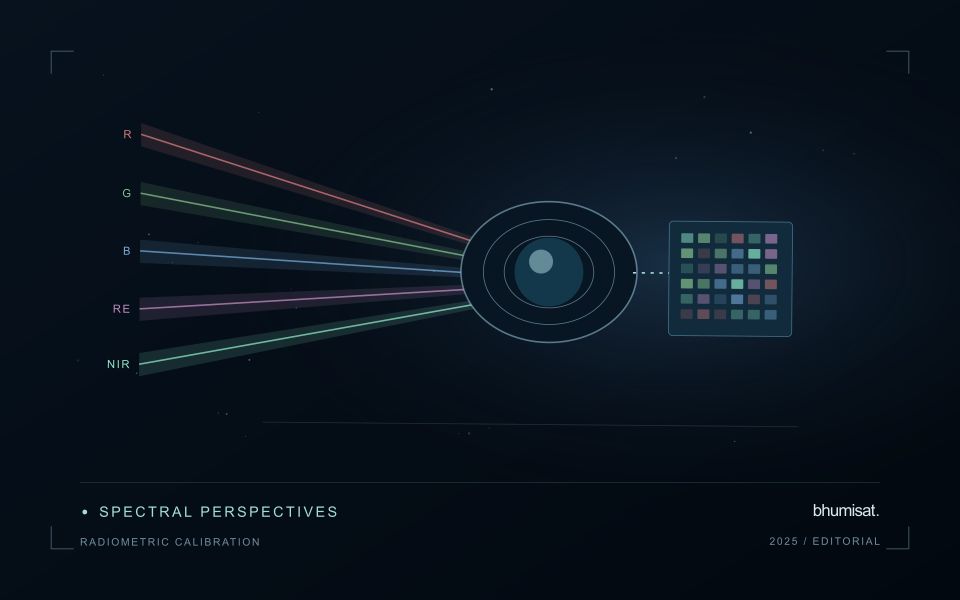
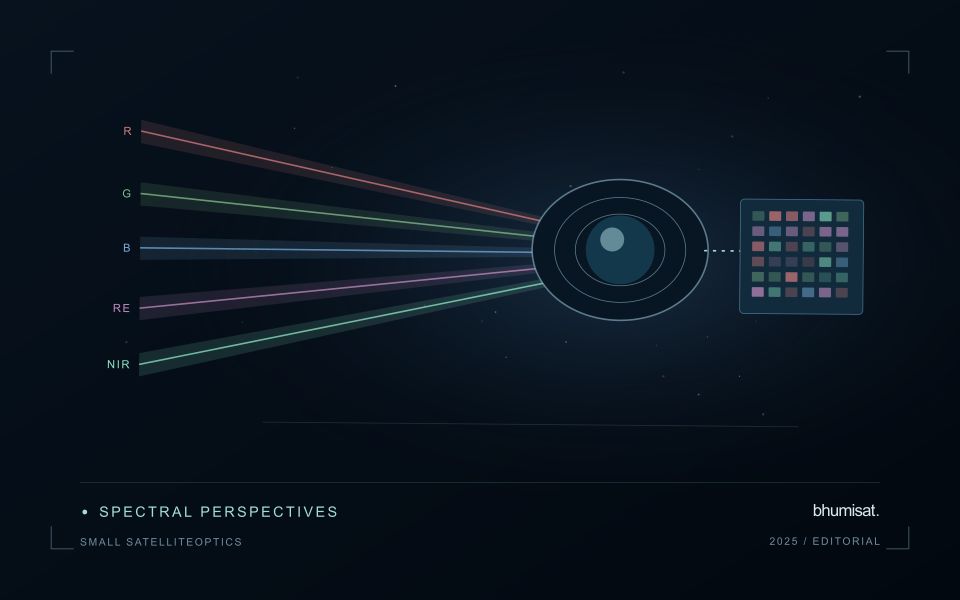
An optical Earth observation payload turns incoming radiance into sampled measurements. Its usefulness depends on more than the ground size represented by a pixel. The aperture, focal length, detector characteristics, spectral response and operating environment all influence the information that survives into the image. A mission should choose these features around a target measurement and its expected brightness, rather than treating pixel spacing as a complete performance specification.
Ground sampling distance describes the spacing of samples on the surface for a specified viewing geometry. Optical blur, detector response, motion and processing can reduce the detail that is actually resolved. The modulation transfer function expresses how contrast is retained across spatial frequencies and helps connect component performance with final image sharpness. Smaller pixels alone cannot recover detail removed by the optical system or excessive image motion.
Balance signal, packaging and calibration
A larger entrance aperture can collect more light, but it also creates demands on mass, volume, alignment and thermal control. Narrow spectral bands collect less energy than broader bands under otherwise comparable conditions. Longer integration can improve signal collection until motion, saturation or other constraints become limiting. The resulting trade must be evaluated for dark targets as well as bright land, and for the expected range of illumination and atmospheric conditions.
Small spacecraft packaging makes mechanical and thermal interfaces particularly consequential. Focus and alignment can shift as temperatures change, while launch loads and contamination can affect performance. Stray light from outside the intended field can bias measurements even when an image appears visually acceptable. Baffles, suitable materials, cleanliness procedures and representative testing help control these effects. Detector defects, nonuniform response and electronic noise also require characterization.
Plan radiometric, geometric and spectral calibration with the payload design. Establish how ground tests connect to measurements after launch, and how changes in response will be monitored. The calibration record should describe uncertainties and conditions, rather than just providing a correction file. Evaluate the complete imaging chain using representative scenes and realistic motion assumptions. A credible specification states where performance is expected, how it will be measured and which tradeoffs were accepted. It should not turn a detector data sheet into an unsupported claim about an entire spacecraft.
Deliver quality flags that users can interpret
Quality information should describe the condition of an observation in terms that remain useful through the workflow. A single valid or invalid label may be sufficient for some calculations, but operational users often need to know why an observation was qualified. Distinguish acquisition limitations, processing failures, uncertain reference matches, and conditions that make interpretation ambiguous. These categories point towards different responses and should not be merged without a clear purpose.
Define a small, documented set of flags with stable meanings. Record whether a flag applies to a complete scene, a geographic unit, an individual measurement, or a derived result. A unit containing a mixture of qualified and unqualified observations may also require a coverage measure. Include the rule used to combine flags when summarising data so that a favourable average does not conceal a substantial fraction of unusable input.
Test the flags with the people receiving the product. Ask what they would do differently for each state and whether the terminology supports that choice. Keep the original flags available even if the interface presents a simpler summary. When flag definitions change, version the rules and review their effects on historical comparisons. Useful quality communication makes the condition of the evidence visible at the moment when a user decides how much confidence to place in the result.
Check readiness before an acquisition
An acquisition plan should consider the complete sequence needed to obtain a usable observation. Define the target, the required configuration, the timing opportunity, and the conditions under which the observation should proceed. For a spacecraft study, this includes the relationships between pointing, instrument operation, available resources, and data handling. For other observation platforms, the same principle applies: a valid measurement depends on more than the presence of a suitable sensor.
Use a readiness checklist tied to the intended acquisition rather than a generic declaration that the system is available. Confirm the relevant configuration, geographic information, time references, storage capacity, and expected data products. Identify conditions that require postponement or a revised plan. Where resource estimates are uncertain, state the assumption and test its consequences before treating it as an operational margin.
Review the acquisition after it occurs or after a representative simulation. Compare the planned sequence with the evidence actually produced, including metadata, coverage, and quality information. Record incomplete acquisitions as useful evidence about the workflow rather than silently excluding them from the record. Repeated reviews can reveal whether a limitation arises from planning, platform behaviour, instrument operation, or processing. This creates a disciplined route from an observation opportunity to a dependable measurement capability.
Bring the evidence back to the decision
A strong interpretation states what was observed, which explanations remain plausible, and what additional evidence would help distinguish them. Avoid presenting a convenient label as a confirmed cause when the measurements support only a broader pattern. Connect the proposed next step to the significance of the decision and the confidence available. This creates an interpretation that a field team, analyst, or project partner can examine, challenge, and improve as further observations become available.
Sources & further reading
Explore the bhumisat spacecraft concept and our vision towards 2030, or return to the journal.