Every observation and interpretation contains uncertainty, but the sources and consequences of that uncertainty differ between applications. Some arise from acquisition conditions, others from reference measurements, processing choices, or the transfer of a model to a new setting. This perspective examines how those sources affect the decision a user is considering. It encourages teams to describe uncertainty in a form that can influence action, rather than adding a generic qualification at the end of a report. The objective is to support proportionate decisions while keeping the limits of the available evidence understandable.
This working guide considers radiometric calibration and reflectance consistency during multisensor field campaigns. The immediate decision is to align observations across measurement scales. Useful reference evidence includes coordinated timestamps, sample support and instrument reference records. The case is an illustrative planning context, with assumptions to check against the actual sensor, landscape and project requirements.
The setting: Multisensor field campaigns
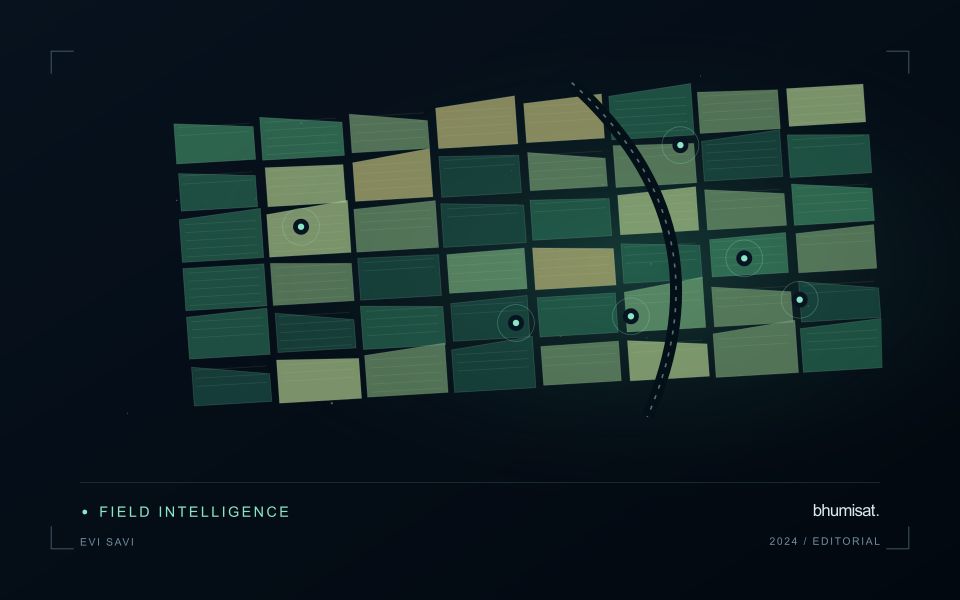
A multisensor field campaign brings together observations that may represent different surfaces, times and spatial scales. A ground measurement can describe a small sample, a drone product a local scene and a satellite observation a wider footprint. Their values should not be expected to match automatically. Define the variable of interest and the area represented by each method before treating the campaign as a direct comparison between interchangeable measurements.
Coordination should account for acquisition timing, crop or environmental change, positioning and the conditions relevant to each instrument. Record whether a sample represents a plot interior, an edge mixture or another setting that influences its relationship with imagery. A common coordinate reference helps align the observations, but it does not remove differences in measurement support. Aggregation and comparison rules should be chosen to address those differences explicitly rather than only making the maps look aligned.
The evaluation should preserve uncertainty in both the reference data and the remotely sensed products. Include representative ordinary conditions as well as unusual sites, and keep development samples separate from independent assessment where a model is being tested. A successful relationship within one campaign does not establish transfer to all other settings. The useful outcome is a traceable account of how the observations relate, where they disagree and what those disagreements reveal about the proposed application.
Define the quantity that the instrument records
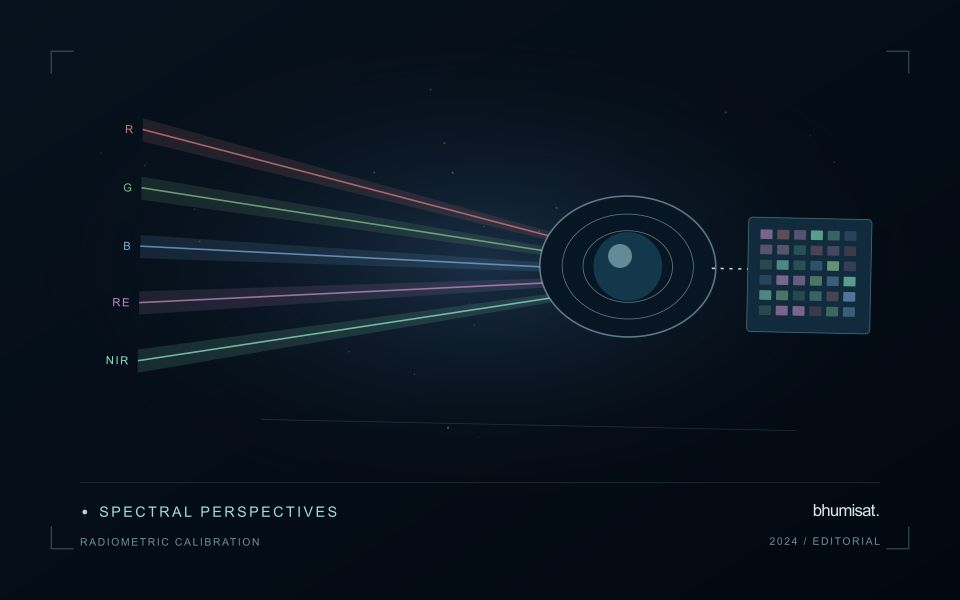
Radiometric calibration establishes a documented relationship between an instrument's recorded output and the physical quantity it is intended to represent. A stored pixel value may be a digital number, a scaled radiance or reflectance value, or another processed representation. Those alternatives should not be treated as interchangeable. The calibration chain explains how the recorded signal becomes an interpretable measurement and which corrections have already been applied. Understanding that chain is essential before comparing dates, combining bands or transferring a model between instruments.
Instrument response can vary across detectors, channels and operating conditions. Calibration therefore concerns more than selecting one conversion coefficient. A study may need to consider offsets, response differences, noise, saturation and changes in behaviour over time. The appropriate characterisation depends on the instrument and its intended use. For a future payload concept, these are requirements to investigate rather than capabilities established by an attractive render. The presence of a multispectral camera alone does not demonstrate that its channels produce consistent, quantitatively comparable observations.
Track consistency through the complete chain
At the product level, begin with the supplier's definitions and metadata. Check scale factors, additive offsets, fill values and valid ranges before deriving an index or statistical summary. Preserve the processing version so that an output can be reproduced later. Inspect whether extreme values correspond to real surfaces or to invalid observations. When a dataset is updated, compare representative old and new results rather than assuming that a familiar file name guarantees an unchanged numerical meaning throughout the archive.
Validation should cover the full chain that supports the stated application. A stable response in a laboratory test is valuable evidence, while operational imagery introduces additional effects from atmosphere, geometry and scene complexity. Use independent references suited to the measurement scale and report the relevant uncertainty. Maintain a record of corrections and their limitations when delivering results to users. A traceable radiometric workflow supports meaningful comparisons and helps separate a change in the observation system from a change in the landscape that a monitoring service is trying to describe.
Preserve a reproducible processing history
A result should be linked to the inputs and processing choices that produced it. Record source identifiers, software versions, configuration values, reference data versions, and the time of processing. The record does not need to expose every internal implementation detail to the end user. It must preserve enough information for the producing team to investigate a result, reproduce a comparison, and explain why a revised product differs from an earlier version.
Version changes that can affect the meaning of the output. Updated boundaries, a new quality mask, revised calibration, different model parameters, or altered aggregation rules can all change results even when the source imagery is unchanged. Avoid overwriting an earlier product without retaining a suitable history. A clear relationship between versions helps users distinguish an improvement in processing from a real change in the observed surface.
Use representative regression cases when modifying the workflow. Select cases that cover ordinary conditions and known failure modes, then compare meaningful outputs before and after the change. Investigate differences against the intended purpose of the revision rather than assuming that a closer visual match is always preferable. Preserve the review decision with the version record. Reproducibility becomes practical when the team can trace a result through a documented sequence of inputs, transformations, tests, and delivery decisions.
Plan the evidence needed for calibration
Calibration connects an instrument's recorded response with a measurement that can be interpreted consistently. Begin by identifying which aspects of the response matter to the application: variation across channels, changes with operating conditions, geometric alignment, or differences between repeated observations. A calibration plan should state the quantities being assessed and the evidence needed to determine whether the response is sufficiently characterised for the intended use.
Design tests around controlled and documented conditions. Record the reference source, instrument configuration, exposure settings, temperature conditions, and processing applied to the measurements. Repeat suitable observations to investigate variability and distinguish a consistent response from a single favourable result. The reference itself has limitations, so preserve its characterisation and avoid assuming that every difference originates in the instrument under evaluation.
Connect calibration activities with the expected operating environment and processing chain. A correction that works under one test condition may require further evidence before being applied elsewhere. Define how calibration parameters are versioned, checked, and associated with the observations they support. Include a plan for recognising drift or other changes that could affect interpretation. The outcome should be an instrument response supported by traceable evidence, together with acceptance criteria that remain relevant to the application.
Bring the evidence back to the decision
Useful uncertainty communication identifies the limitation, explains how it could affect the result, and connects it to a practical response. Some decisions can proceed with a qualified estimate; others require another observation or an independent check. Preserve uncertainty information through processing and delivery so that it is available at the point of use. This makes the analysis more accountable and gives the team a clearer basis for deciding which additional evidence would most improve the outcome.
Sources & further reading
Explore the bhumisat spacecraft concept and our vision towards 2030, or return to the journal.