A workflow that succeeds on a small study area may encounter different constraints when the number of observations, locations, or users increases. Scaling requires attention to processing capacity, data organisation, reference coverage, and the effort needed to review results. This perspective looks beyond whether a calculation can run on a larger dataset. It asks whether the complete service can preserve its meaning, quality, and delivery commitments as its scope expands. The objective is a design that identifies bottlenecks early and increases throughput without silently weakening the evidence available to users.
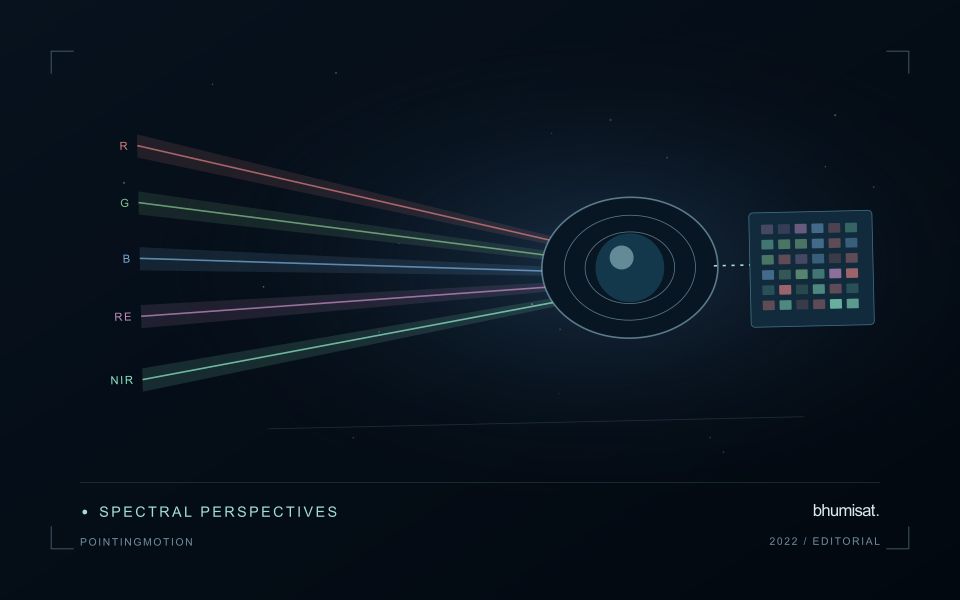
This working guide considers how pointing and motion affect satellite imagery within mission readiness studies. The immediate decision is to connect mission claims to measured evidence. Useful reference evidence includes documented requirements, test results and unresolved design questions. The case is an illustrative planning context, with assumptions to check against the actual sensor, landscape and project requirements.
Separate the different pointing requirements
A camera can point near its intended target while still producing an image with poor geometry or blur. Pointing accuracy describes how closely the spacecraft achieves a commanded orientation. Pointing knowledge describes how well that orientation is estimated. Stability concerns changes over a relevant interval, including the detector integration period. These quantities serve different purposes and should be specified separately with a clear reference frame and time basis.
Orientation estimates combine information from sensors such as gyroscopes, Sun sensors and star trackers, depending on the architecture. Actuators then change or maintain the attitude. Reaction wheels exchange angular momentum with the spacecraft, while magnetic torquers interact with Earth's magnetic field and may support momentum management. Their suitability depends on the orbit, operating modes and disturbance environment. A component's advertised accuracy does not automatically become the pointing performance of the integrated spacecraft.
Evaluate the complete image motion budget
Ground features move across a detector because the spacecraft travels along its orbit and may rotate during imaging. Exposure time, scan timing and any motion compensation must be consistent with that movement. Residual motion during integration spreads signal across pixels and reduces contrast. High frequency vibration can produce a different image effect from slow drift, so one average attitude error may conceal an important problem.
Build an image motion budget that includes control behavior, structural response, actuator disturbances and timing uncertainties. Consider the mechanical path between attitude sensors and the optical payload: a flexible interface can change their relative alignment. Thermal distortion can also alter boresight alignment over an orbit. Test realistic operating combinations, including wheel speeds and other mechanisms that may run during an exposure, and assess whether laboratory support equipment affects the measurement.
Geometric processing uses orbit information, attitude knowledge, timing and an Earth model to locate observations. Ground control and image matching can improve some errors, but processing cannot always restore information lost to blur. For repeat observations, test relative registration as well as absolute location. Report residual errors across the field and across relevant operating conditions. A useful requirement links a user consequence, such as registration between spectral bands, to a measurable spacecraft or payload behavior and a verification method. This keeps pointing discussions connected to the quality of the delivered imagery.
The setting: Mission readiness studies
A mission readiness study connects the intended application with the evidence available from the spacecraft and ground system. A target launch year or an attractive rendering can help communicate a vision, but neither establishes that the observation service is ready. Begin with the capabilities the mission is supposed to demonstrate and identify how each will be assessed. Requirements should remain traceable to user needs rather than accumulating as an unrelated list of desirable specifications.
The review should consider the observation payload, pointing, power, communications, processing and delivery as parts of one chain. A promising subsystem test may still leave an important gap elsewhere in that chain. Record the conditions under which each result was obtained, the applicable uncertainty and the design version it represents. Changes in architecture or application requirements should trigger a review of which earlier evidence remains relevant and which measurements need to be repeated.
Progress can be organised around clear evidence milestones, including application trials, integrated testing and documented end-to-end demonstrations. Keep unresolved questions visible and distinguish a proposed capability from a measured one. A finding that leads to a design change is valuable information when it improves the match between the mission and its intended use. The practical result is a defensible account of readiness, remaining work and the conditions that must be satisfied before a stronger public performance claim can be supported.
Check readiness before an acquisition
An acquisition plan should consider the complete sequence needed to obtain a usable observation. Define the target, the required configuration, the timing opportunity, and the conditions under which the observation should proceed. For a spacecraft study, this includes the relationships between pointing, instrument operation, available resources, and data handling. For other observation platforms, the same principle applies: a valid measurement depends on more than the presence of a suitable sensor.
Use a readiness checklist tied to the intended acquisition rather than a generic declaration that the system is available. Confirm the relevant configuration, geographic information, time references, storage capacity, and expected data products. Identify conditions that require postponement or a revised plan. Where resource estimates are uncertain, state the assumption and test its consequences before treating it as an operational margin.
Review the acquisition after it occurs or after a representative simulation. Compare the planned sequence with the evidence actually produced, including metadata, coverage, and quality information. Record incomplete acquisitions as useful evidence about the workflow rather than silently excluding them from the record. Repeated reviews can reveal whether a limitation arises from planning, platform behaviour, instrument operation, or processing. This creates a disciplined route from an observation opportunity to a dependable measurement capability.
Translate the decision into observation requirements
Start with the decision that the information is intended to support. Describe the geographic unit, the time available for acting, and the consequence of an incorrect interpretation. A requirement such as detecting an unusual pattern across management blocks is different from identifying its cause. Keeping that distinction explicit helps a team select measurements that are relevant to the application and prevents later evaluation from drifting towards whatever result happens to be easiest to demonstrate.
Build a compact requirements matrix linking each decision to the evidence needed, the proposed observation source, and an acceptance condition. Include geographic accuracy, temporal relevance, quality screening, and the context required for interpretation. The matrix should also identify the evidence used to justify each requirement. An engineering preference or a convenient data source can inform a study, but neither should silently replace a documented information need.
Review the matrix with the people who will use the result. Ask how their response would change when information is delayed, incomplete, or uncertain. Record unresolved requirements as questions for a pilot rather than converting them into confident specifications. This produces a practical framework for comparing technical options, designing tests, and explaining why an observation is useful to the intended workflow.
Bring the evidence back to the decision
Expansion should be guided by measured workload, visible quality conditions, and an understanding of which tasks require expert attention. Test the workflow under representative data volumes before treating a successful demonstration as evidence of operational capacity. Preserve a route for investigating individual observations even when most processing is automated. A scalable service keeps its results traceable and useful as it grows, with clear choices about where to automate, where to review, and where to invest in additional evidence.
Sources & further reading
Explore the bhumisat spacecraft concept and our vision towards 2030, or return to the journal.