An analytical result becomes operational information only when the receiving team can understand it and use it within existing responsibilities. Handoffs often fail because assumptions that were obvious to the analyst are absent from the delivered product. This perspective considers the information needed at that boundary: acquisition time, processing status, geographic scope, quality qualifications, and the action expected from the recipient. It also asks how corrections and feedback should return to the producing team. A dependable handoff creates a shared understanding of the result, rather than merely transferring a file.
This working guide considers ndre and crop canopy interpretation in sugarcane production blocks. The immediate decision is to sequence scouting and harvest review. Useful reference evidence includes planting or ratoon dates and dated canopy observations. The case is an illustrative planning context, with assumptions to check against the actual sensor, landscape and project requirements.
Define the Red Edge measurement precisely
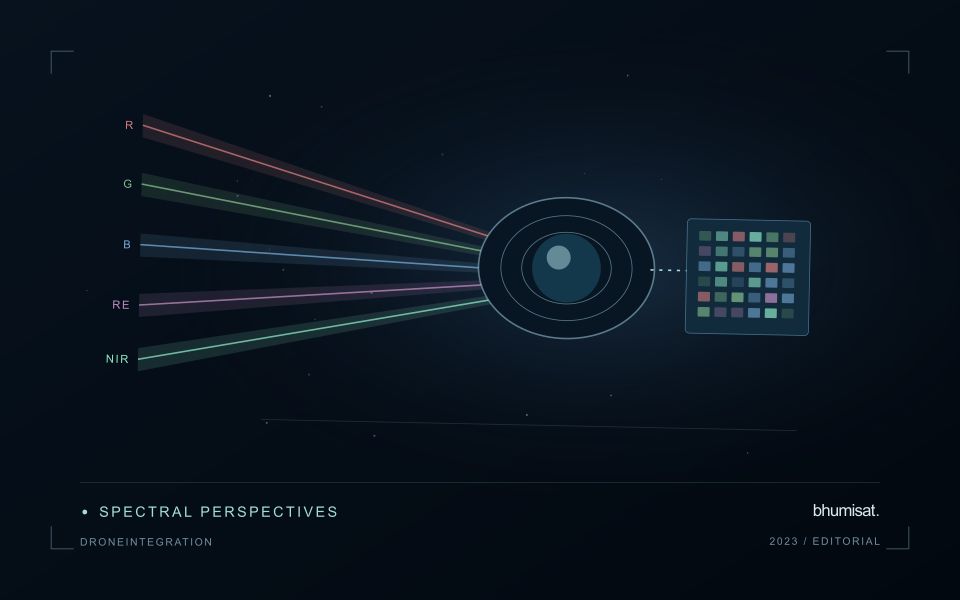
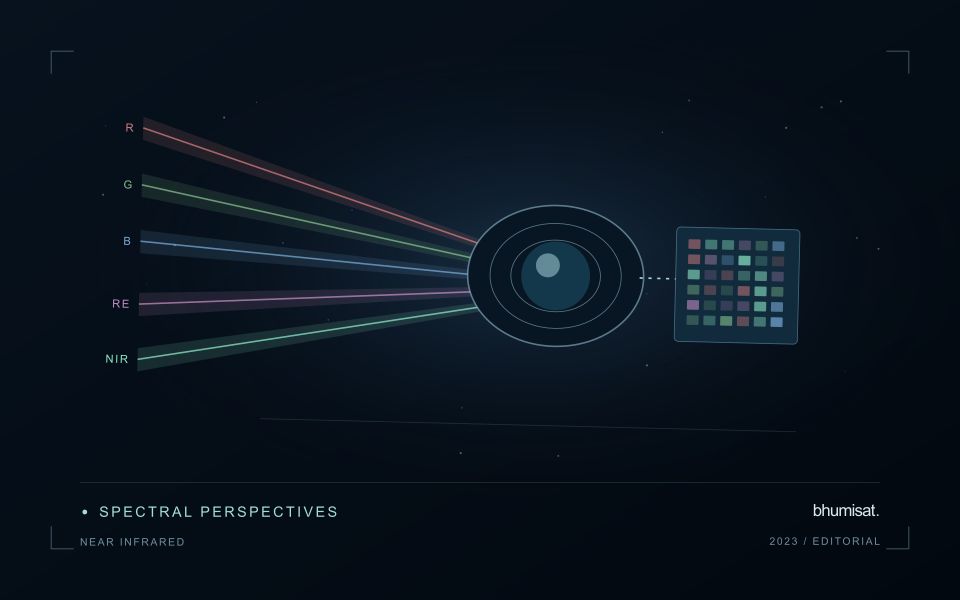
NDRE uses the contrast between near-infrared reflectance and a selected Red Edge band, commonly expressed as a normalised difference. Its meaning depends on the actual spectral response of those channels. Two instruments described as having Red Edge capability may observe different wavelength intervals, so their index values are not automatically interchangeable. Record the selected bands, the product level and any resampling applied to them. This is particularly important when a monitoring service combines observations from several satellite or aerial instruments.
The Red Edge region captures a transition between strong absorption in red wavelengths and the higher reflectance often observed in near-infrared wavelengths over vegetation. A measurement in that transition can provide information that differs from a conventional red band. However, canopy structure, growth stage, soil visibility and illumination also influence the observed signal. An apparent improvement over another index should be demonstrated for a defined crop parameter and evaluation dataset, rather than inferred from the presence of an additional spectral channel alone.
Separate spectral sensitivity from agronomic evidence
A sound comparison uses compatible surface reflectance inputs and observations of similar quality. Inspect cloud edges, shadows, band alignment and field boundaries before interpreting small changes. Bands with different native spatial sampling may require a common grid, but resampling does not create new measured ground detail. Where the field contains only a few usable pixels, boundary mixing can dominate the result. Summarising an interior area separately from the full field can help reveal that sensitivity, provided the exclusion rule is documented consistently.
An agricultural model built around NDRE needs independent measurements of the parameter it claims to estimate. If the objective concerns leaf or canopy condition, the field protocol should specify what is measured, where, when and at what scale. Keep calibration observations separate from the final evaluation sample. Examine performance across crop ages and management regimes, including difficult cases. The resulting evidence can support a targeted application, while uncertainty and sampling limits remain visible. A spectral response is an observation; an agronomic conclusion requires an additional, tested relationship.
The setting: Sugarcane production blocks
Sugarcane monitoring depends on knowing where each block sits within a management cycle. A recently planted field, an established ratoon and a block approaching harvest can have very different canopy structures without any of them indicating a problem. Maintain planting and harvest dates alongside block boundaries, and distinguish crop establishment from regrowth. This context gives a time series a meaningful starting point and prevents comparisons between fields at unrelated stages.
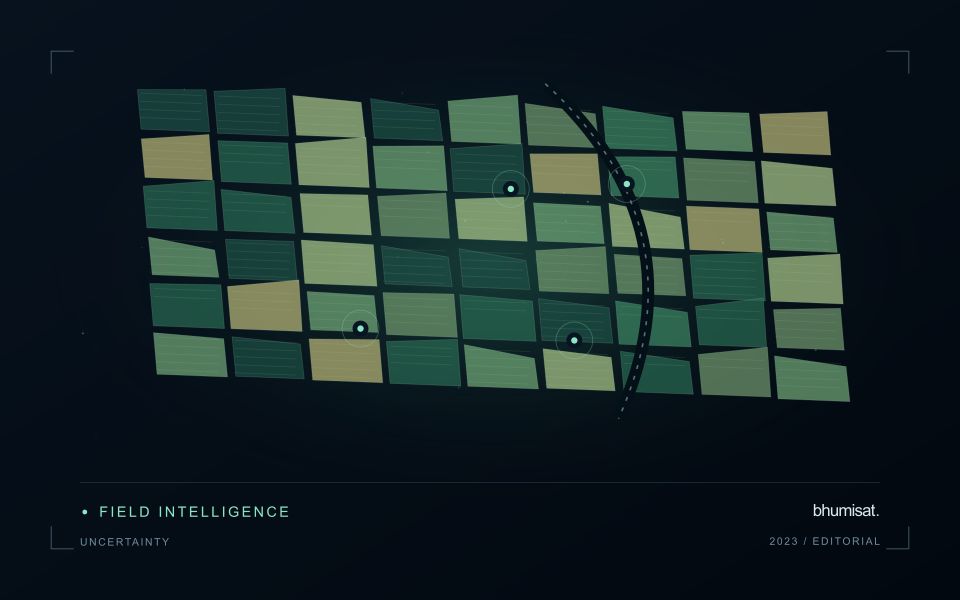
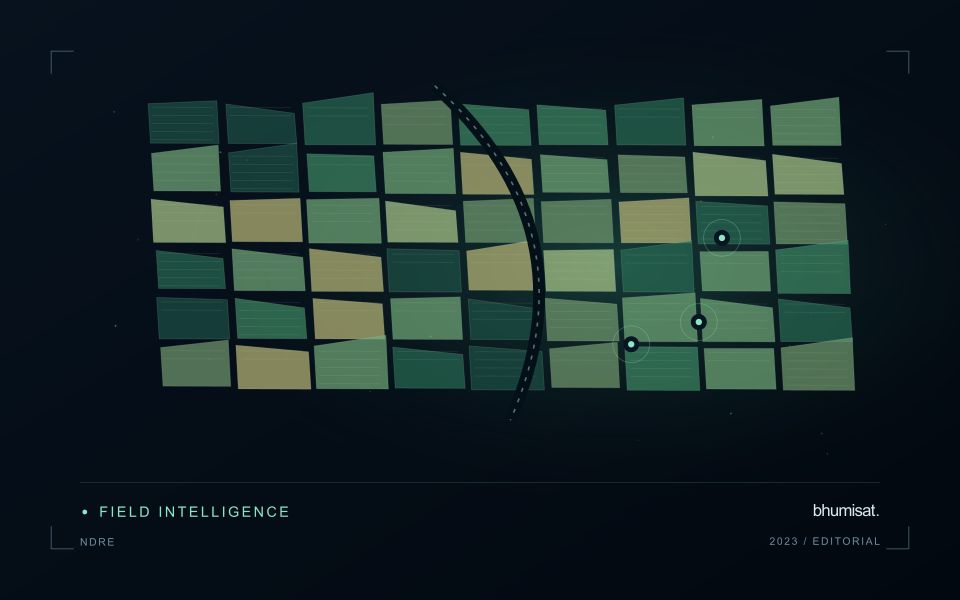
A useful workflow follows the development of each block through successive quality-screened observations. Look for departures from comparable blocks or from a documented local seasonal pattern, rather than applying a single threshold across the whole estate. Harvest operations, residue management, bare soil and weeds can all affect the surface signal. Track these events in the same record as the imagery so that the analytical timeline reflects what actually happened on the ground.
Field validation should address a defined question, such as whether a flagged area has uneven establishment or requires an agronomic visit. Record crop stage, stand continuity, management history and the location of observations within the block. Predictions related to production need suitable harvest measurements and evaluation across seasons. A map that helps organise scouting is useful evidence of a workflow; it is not automatically a validated estimate of cane tonnage.
Translate the decision into observation requirements
Start with the decision that the information is intended to support. Describe the geographic unit, the time available for acting, and the consequence of an incorrect interpretation. A requirement such as detecting an unusual pattern across management blocks is different from identifying its cause. Keeping that distinction explicit helps a team select measurements that are relevant to the application and prevents later evaluation from drifting towards whatever result happens to be easiest to demonstrate.
Build a compact requirements matrix linking each decision to the evidence needed, the proposed observation source, and an acceptance condition. Include geographic accuracy, temporal relevance, quality screening, and the context required for interpretation. The matrix should also identify the evidence used to justify each requirement. An engineering preference or a convenient data source can inform a study, but neither should silently replace a documented information need.
Review the matrix with the people who will use the result. Ask how their response would change when information is delayed, incomplete, or uncertain. Record unresolved requirements as questions for a pilot rather than converting them into confident specifications. This produces a practical framework for comparing technical options, designing tests, and explaining why an observation is useful to the intended workflow.
Represent gaps without inventing observations
A monitoring sequence often contains periods without a usable observation. The reason may be cloud, shadow, missing coverage, a failed transfer, or a quality condition that excludes the data. Begin by representing these states explicitly. A missing observation is different from a low measurement, an unchanged surface, or a confirmed absence of the feature being studied. The distinction should survive both the analysis and the presentation of the result.
Define when a temporal gap is acceptable for the intended decision. A workflow may continue using the latest qualified observation, request another source, or suspend an alert until sufficient evidence is available. Whichever response is selected, show the age of the supporting observation. If interpolation is used for a suitable analytical purpose, preserve the distinction between an estimated value and a directly observed measurement, together with the assumptions needed to interpret it.
Review how gaps affect the coverage of the final evaluation. Locations with frequent missing data may differ systematically from those with regular observations. A performance estimate based only on clear, complete records can therefore describe a narrower population than the service is expected to support. Report usable coverage alongside analytical results and use recurring gaps to guide acquisition planning, reference collection, and the selection of complementary observation methods.
Bring the evidence back to the decision
A successful handoff leaves the recipient with a clear result, sufficient context, and a practical route for raising questions. Test the delivery with the people who will use it, including how they respond when observations are missing or qualified. Capture their feedback as evidence for improving the product. The most useful delivery format is the one that preserves the relevant technical meaning while fitting the decisions, time constraints, and responsibilities of its intended audience.
Sources & further reading
Explore the bhumisat spacecraft concept and our vision towards 2030, or return to the journal.