A useful observation programme begins with a decision that somebody can act on. Before selecting imagery or instruments, define the area of interest, the people responsible for inspecting it, and the time available for a response. This planning perspective connects remote measurements with the practical questions that shape a survey or monitoring service. The aim is to identify which observations would change a decision, how supporting evidence would be collected, and what should happen when information is incomplete. A clear plan makes later technical choices easier to assess against an operational purpose.
This working guide considers ndre and crop canopy interpretation in rubber estate blocks. The immediate decision is to plan inspections around canopy transitions. Useful reference evidence includes leafing stage, tree age and block management records. The case is an illustrative planning context, with assumptions to check against the actual sensor, landscape and project requirements.
The setting: Rubber estate blocks
Rubber estates contain stands of different ages, canopy structures and management histories. Seasonal leaf changes can also influence the image record, so a shift in vegetation response should not automatically be treated as deterioration. Interpret observations with a local calendar and a clear definition of the target variable. The first question is whether the service concerns plantation cover, stand development, management activity or a more specific operational indicator.
Build a block inventory that separates mature stands, young plantings, open areas and other land covers where possible. Compare observations from suitable periods and inspect whether cloud, shadow or haze has affected the available measurements. Roads, drainage lines and conservation vegetation may require separate treatment. A numerical difference between blocks is more informative when the report also shows their stand context and the actual dates on which usable observations were collected.
Validation should record tree age, canopy condition, leafing stage and relevant recent operations at identified locations. Commercial output records may be influenced by factors beyond the remotely observed canopy, so any relationship with production must be tested for the intended use. Field staff should be able to distinguish a satellite-derived inspection priority from a confirmed explanation. Retaining the outcome of follow-up visits helps reveal both useful alerts and situations where the mapped pattern had an ordinary management explanation.
Define the Red Edge measurement precisely
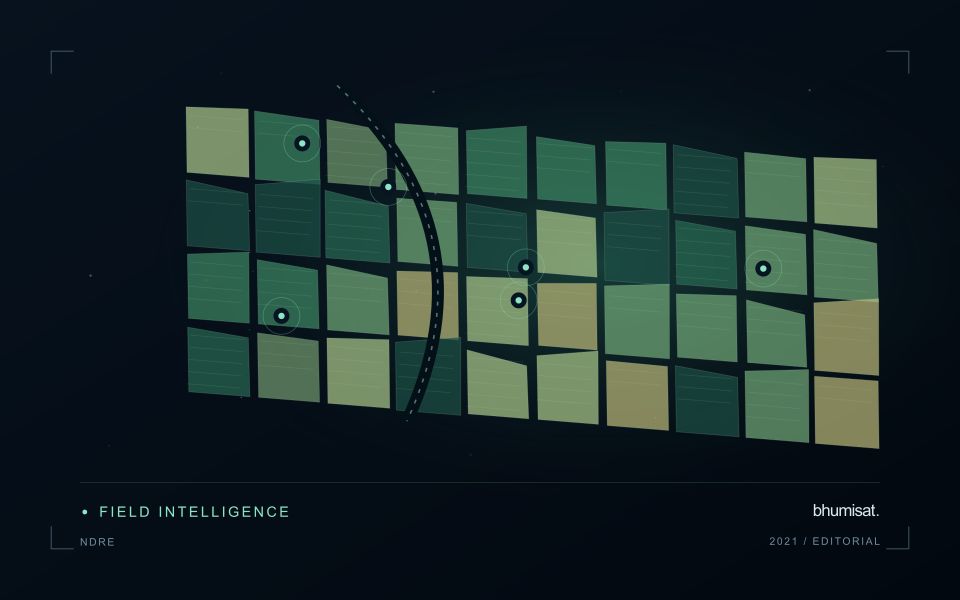
NDRE uses the contrast between near-infrared reflectance and a selected Red Edge band, commonly expressed as a normalised difference. Its meaning depends on the actual spectral response of those channels. Two instruments described as having Red Edge capability may observe different wavelength intervals, so their index values are not automatically interchangeable. Record the selected bands, the product level and any resampling applied to them. This is particularly important when a monitoring service combines observations from several satellite or aerial instruments.
The Red Edge region captures a transition between strong absorption in red wavelengths and the higher reflectance often observed in near-infrared wavelengths over vegetation. A measurement in that transition can provide information that differs from a conventional red band. However, canopy structure, growth stage, soil visibility and illumination also influence the observed signal. An apparent improvement over another index should be demonstrated for a defined crop parameter and evaluation dataset, rather than inferred from the presence of an additional spectral channel alone.
Separate spectral sensitivity from agronomic evidence
A sound comparison uses compatible surface reflectance inputs and observations of similar quality. Inspect cloud edges, shadows, band alignment and field boundaries before interpreting small changes. Bands with different native spatial sampling may require a common grid, but resampling does not create new measured ground detail. Where the field contains only a few usable pixels, boundary mixing can dominate the result. Summarising an interior area separately from the full field can help reveal that sensitivity, provided the exclusion rule is documented consistently.
An agricultural model built around NDRE needs independent measurements of the parameter it claims to estimate. If the objective concerns leaf or canopy condition, the field protocol should specify what is measured, where, when and at what scale. Keep calibration observations separate from the final evaluation sample. Examine performance across crop ages and management regimes, including difficult cases. The resulting evidence can support a targeted application, while uncertainty and sampling limits remain visible. A spectral response is an observation; an agronomic conclusion requires an additional, tested relationship.
Match the timing of reference observations
The value of a reference measurement depends partly on how well its timing matches the observation being evaluated. A surface, crop, water body, or instrument state may change between the two measurements. Start by documenting the acquisition time of every source and the period over which the reference observation applies. Avoid treating a date entered during data upload as though it were necessarily the time when the measurement was collected.
Define an acceptable timing relationship for the application. A slowly changing structural feature may tolerate a broader comparison window than a rapidly changing surface condition. The window should be justified by the process being studied and by any available contextual records. If conditions change within that period, consider separating the observations into suitable groups rather than combining them under a single assumption of comparability.
Preserve information about interventions and events between observations. A management operation, rainfall episode, disturbance, or change in sensor configuration can alter the interpretation of a comparison. Record the event and decide whether the pair remains suitable for evaluation. Where the timing mismatch cannot be resolved, describe the comparison as qualified evidence. This is more informative than allowing an uncertain match to influence a performance statistic without explanation.
Keep an auditable review record
A review record should explain how a result moved from an analytical output to an accepted interpretation or operational decision. Preserve the product identifier, the evidence considered, the reviewer role, and the outcome of the review. A short, consistent record is often more useful than an extensive free-text note that cannot be compared between cases. The objective is to make important decisions traceable without turning routine review into unnecessary administrative work.
Separate observations from conclusions within the record. Describe the evidence visible to the reviewer, the alternative explanations considered where relevant, and the reason for accepting, qualifying, or rejecting the result. If a correction is required, identify what should change and how the revised product relates to the earlier version. Keep unresolved questions visible so that they can be addressed by another observation or by the person responsible for the next action.
Use the accumulated record to improve the workflow. Recurring review reasons can reveal unclear requirements, missing contextual information, unstable processing steps, or an evaluation gap. Examine whether similar cases receive similar decisions across reviewers and over time. Preserve the relationship between feedback and subsequent revisions so that improvements can be assessed against the evidence that motivated them. An auditable record supports learning, accountability, and consistent delivery while allowing the technical process to evolve.
Bring the evidence back to the decision
The practical outcome should be a short observation plan that another team can follow. It should name the decision, the required evidence, the responsible roles, and the conditions that trigger a field visit or further analysis. Keep the plan small enough to test, then revise it using the results of real inspections. A useful monitoring workflow improves because its assumptions are examined systematically, and its observations remain connected to decisions throughout the process.
Sources & further reading
Explore the bhumisat spacecraft concept and our vision towards 2030, or return to the journal.