Comparisons through time are valuable only when the observations are sufficiently comparable for the question being asked. A difference between dates can reflect real change, a normal stage in a seasonal cycle, or a difference in how the surface was observed. This perspective examines the reference period, the timing of acquisitions, and the contextual records needed to interpret a sequence. It encourages the use of appropriate baselines rather than treating every previous observation as an equivalent benchmark. The objective is to identify changes that remain meaningful after normal variation and measurement conditions are considered.
This working guide considers writing requirements from an earth observation need in rainfed rice landscapes. The immediate decision is to focus visits after uneven rainfall. Useful reference evidence includes planting dates, field moisture observations and crop stage. The case is an illustrative planning context, with assumptions to check against the actual sensor, landscape and project requirements.
Translate a user decision into measurable behavior
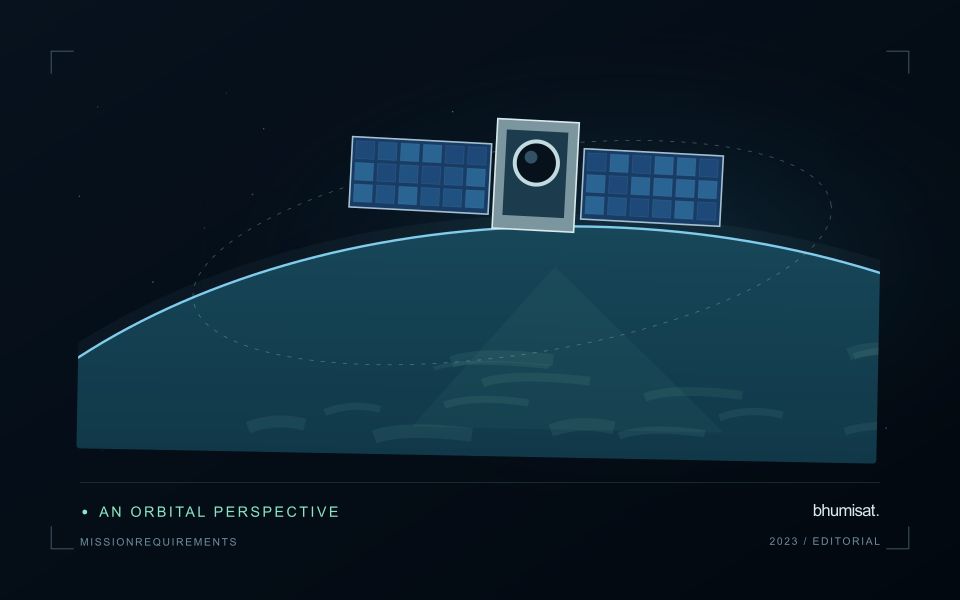
A mission requirement should connect to a decision that someone needs to make with the observations. Begin by defining the target phenomenon, geographic area, relevant season and consequence of delay or error. A request to monitor crops is too broad to guide a spacecraft design. The useful question is which crop condition must be distinguished, at what field scale, how often, and with what confidence.
Translate these needs into product requirements before allocating spacecraft specifications. Consider spatial detail, spectral information, radiometric performance, location accuracy, usable revisit and delivery latency. Geometric revisit describes observation opportunities; clouds and acquisition constraints can make usable observations much less frequent. Define terms carefully so that a requirement for delivered, cloud screened coverage cannot be satisfied merely by showing an orbit access calculation.
Keep traceability through design and verification
Write individual requirements that can be checked using a stated method and acceptance criterion. Identify the conditions under which each applies, such as target brightness, viewing angle or operating temperature. Avoid combining several unrelated promises in one sentence. Retain a rationale and a link to the higher level need, allowing reviewers to understand why the requirement exists and what would change if it were relaxed.
Allocate performance across the payload, spacecraft, ground segment and processing chain. Image sharpness may depend on optics, detector sampling, motion and resampling. Delivery time may depend on acquisition planning, onboard storage, ground contacts and processing queues. Budgets make these contributions visible and expose conflicts between objectives. Preserve margin where uncertainty remains, and record assumptions rather than hiding them inside an optimistic headline specification.
Plan verification while writing the requirement. Inspection, analysis, demonstration and testing each provide different kinds of evidence. Define the test configuration, reference measurement, uncertainty and pass criterion early enough to influence the design. Verification asks whether the implemented system meets its requirements; validation asks whether that system serves the intended use. Representative users and realistic application examples can reveal an inadequate requirement even when every hardware test passes. Manage revisions through a controlled record that describes their consequences for dependent requirements, budgets and tests. This turns requirements into a working design tool rather than a document assembled only before a review.
The setting: Rainfed rice landscapes
Rainfed rice fields often follow planting calendars shaped by local rainfall, water retention and household decisions. Nearby fields may begin their crop cycles at different times, and some areas may remain unplanted during a reporting period. A monitoring system needs to separate these timing differences from potentially unusual crop development. Start with field boundaries and a record of whether a crop was actually established, together with the best available estimate of its establishment date.
Interpreting an image sequence requires attention to both vegetation and the recent water context. Soil background, temporary standing water and incomplete canopy cover can strongly influence early observations. Rainfall information can help describe the season, but it should not be treated as a direct measurement of water available to every field. Differences in drainage, soil properties and topographic position can create contrasting conditions within a short distance.
Use the analysis to select field questions that can be checked, such as delayed establishment or uneven canopy development. Record crop stage, recent management, visible water conditions and the circumstances that affected planting. Where production estimates are proposed, connect them to representative harvest observations rather than relying on an index threshold. Results should show observation dates and missing periods so that users can judge how current the evidence is before arranging an inspection.
Prioritise alerts using evidence and consequence
An alert is a request for attention, so its design should consider both the evidence available and the cost of responding. Begin by distinguishing a measured change, a proposed interpretation, and the action expected from the recipient. A large numerical difference is not automatically the most urgent case. The significance of the location, the age of the observation, the confidence in the interpretation, and the consequences of delay can all influence priority.
Create a review queue with enough context to support consistent decisions. Useful information can include the supporting dates, quality qualifications, previous observations, geographic unit, and the reason the case entered the queue. Define when an alert can be closed, escalated, or held for another observation. A documented rule is easier to improve than an informal practice that depends entirely on the memory of the operator reviewing the result.
Collect feedback from inspections and operational responses. Record alerts that led to a useful finding, alerts that required no action, and important conditions that the system failed to flag. Review these outcomes across different settings rather than relying only on a total count of alerts. The objective is a queue that directs limited attention towards meaningful decisions, while generating evidence for adjusting thresholds, improving context, and reducing repeated sources of unnecessary work.
Design an evaluation that reflects deployment
A model evaluation should resemble the conditions in which the model will be used. Start by identifying which relationships the development data share: nearby locations, repeated observations of the same unit, common collection teams, or measurements from a single period. These relationships can make records less independent than they appear. An evaluation that ignores them may test the ability to recognise familiar conditions rather than the ability to operate in a new setting.
Choose a split strategy that matches the intended transfer. Holding out locations, seasons, operational units, or acquisition conditions can answer different questions. Document which question each split is designed to address, and keep the held-out evidence separate while selecting features and tuning the method. Repeatedly inspecting the same evaluation set to improve a model gradually makes that set part of development, even if it retains its original label.
Report results at a scale that is meaningful to the user. A strong average can hide poor performance for important subgroups or unusual conditions. Examine error patterns and retain examples of both successful and unsuccessful predictions. Where the evidence covers only a limited range of conditions, describe that range explicitly. The evaluation then becomes a practical guide to suitable use, further testing, and the collection of additional reference observations.
Bring the evidence back to the decision
A useful comparison preserves the dates, quality conditions, and contextual assumptions behind its baseline. Review unusual results against the actual observation sequence rather than relying entirely on a summary statistic. Where seasonal timing is important, describe how comparable stages were identified. The resulting analysis should help users distinguish an informative change from an expected cycle or an observation artefact, while making gaps and remaining uncertainty visible enough to guide further investigation.
Sources & further reading
Explore the bhumisat spacecraft concept and our vision towards 2030, or return to the journal.