A convincing image can still contain measurements that are unsuitable for a particular task. Quality control asks whether the inputs, transformations, and outputs meet the requirements of the intended application. This perspective follows evidence through the workflow, from acquisition metadata and reference observations to the final interpretation. It encourages teams to define acceptance conditions before seeing the result, rather than adjusting them to favour a preferred conclusion. The purpose is a repeatable way to distinguish usable observations, observations requiring qualification, and observations that should be excluded from a decision.
This working guide considers writing requirements from an earth observation need in banana plantation units. The immediate decision is to identify plantation units for closer review. Useful reference evidence includes plant age mixture, canopy continuity and dated field inspections. The case is an illustrative planning context, with assumptions to check against the actual sensor, landscape and project requirements.
The setting: Banana plantation units
Banana production units can contain plants at different stages within a continuously managed system. Replanting, harvesting, leaf management and weather effects can change the canopy pattern at a local scale. A monitoring service should account for that mixture rather than expecting every unit to follow one simple seasonal curve. Define the management boundaries and record how stages are organised within them before interpreting a difference between neighbouring plantation areas.
In humid settings, clouds and shadows can reduce the number of usable optical observations. Retain those gaps explicitly and examine whether the information remains current enough for the intended inspection process. Plantation roads, drainage features and open replacement areas can influence a unit average. Where the proposed output is more detailed than the underlying image support, consider a broader summary or complementary field and drone observations instead of implying plant-level certainty.
Field teams should record stage mixture, canopy condition, recent management and visible events relevant to the sampled area. A vegetation anomaly may justify a visit, but it cannot identify a specific disease or establish production loss on its own. Evaluate models and inspection priorities against representative observations, including normal-looking units. Reports should distinguish the remotely observed pattern from the explanation established during follow-up, allowing plantation staff to use both sources of evidence appropriately.
Translate a user decision into measurable behavior
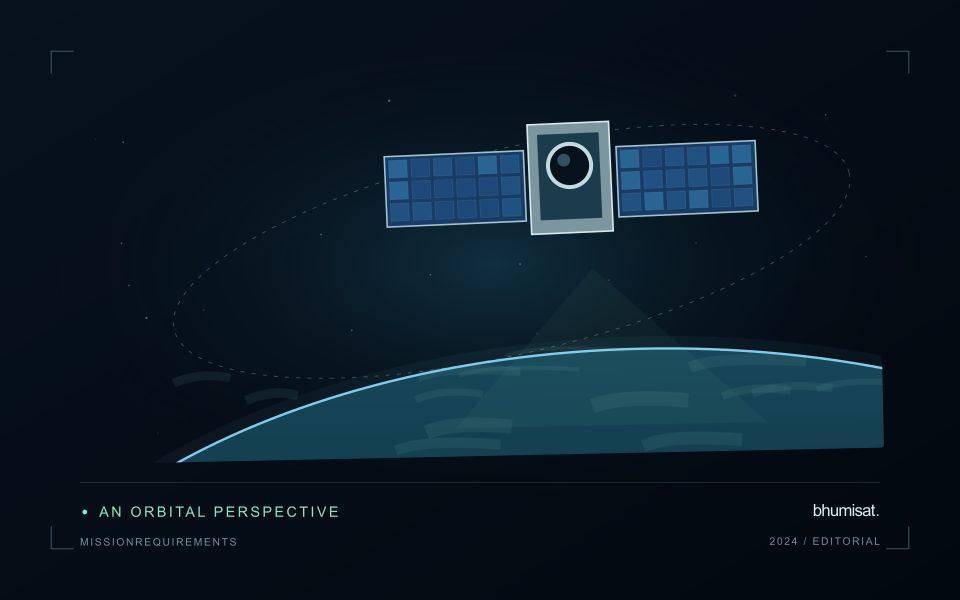
A mission requirement should connect to a decision that someone needs to make with the observations. Begin by defining the target phenomenon, geographic area, relevant season and consequence of delay or error. A request to monitor crops is too broad to guide a spacecraft design. The useful question is which crop condition must be distinguished, at what field scale, how often, and with what confidence.
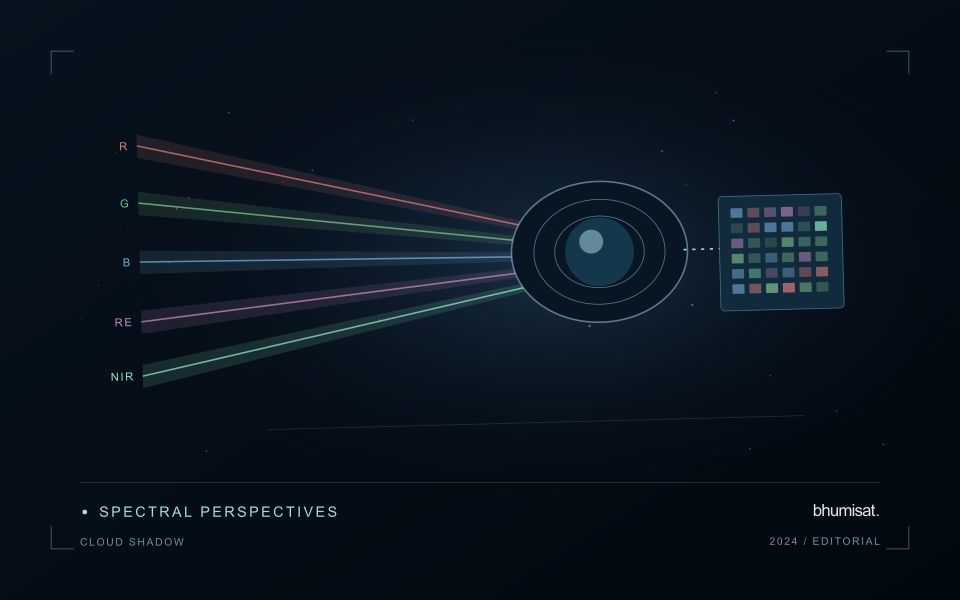
Translate these needs into product requirements before allocating spacecraft specifications. Consider spatial detail, spectral information, radiometric performance, location accuracy, usable revisit and delivery latency. Geometric revisit describes observation opportunities; clouds and acquisition constraints can make usable observations much less frequent. Define terms carefully so that a requirement for delivered, cloud screened coverage cannot be satisfied merely by showing an orbit access calculation.
Keep traceability through design and verification
Write individual requirements that can be checked using a stated method and acceptance criterion. Identify the conditions under which each applies, such as target brightness, viewing angle or operating temperature. Avoid combining several unrelated promises in one sentence. Retain a rationale and a link to the higher level need, allowing reviewers to understand why the requirement exists and what would change if it were relaxed.
Allocate performance across the payload, spacecraft, ground segment and processing chain. Image sharpness may depend on optics, detector sampling, motion and resampling. Delivery time may depend on acquisition planning, onboard storage, ground contacts and processing queues. Budgets make these contributions visible and expose conflicts between objectives. Preserve margin where uncertainty remains, and record assumptions rather than hiding them inside an optimistic headline specification.
Plan verification while writing the requirement. Inspection, analysis, demonstration and testing each provide different kinds of evidence. Define the test configuration, reference measurement, uncertainty and pass criterion early enough to influence the design. Verification asks whether the implemented system meets its requirements; validation asks whether that system serves the intended use. Representative users and realistic application examples can reveal an inadequate requirement even when every hardware test passes. Manage revisions through a controlled record that describes their consequences for dependent requirements, budgets and tests. This turns requirements into a working design tool rather than a document assembled only before a review.
Use observation labels with consistent meanings
A reference label should describe an observation that another person could recognise or reproduce. Broad terms such as good, damaged, or unusual can conceal substantial differences between collection teams. Begin by defining the feature or condition being recorded, the observation unit, and the evidence needed to assign a label. Where possible, distinguish a direct measurement from an interpretation made by the observer.
Provide a short collection guide with examples, boundary cases, and a way to record uncertainty. Train observers using shared cases before relying on independently collected labels. If two observers disagree, preserve the disagreement long enough to understand its cause. It may reveal an unclear definition, a genuinely ambiguous condition, a difference in observation scale, or a problem in matching the reference record to the remote measurement.
Retain the context that makes the label interpretable. Location, time, collection method, observer role, and relevant surface conditions can be essential for later review. Changes to the label scheme should be documented and related to earlier versions where a defensible correspondence exists. Consistent labels do not eliminate uncertainty, but they make it possible to investigate disagreement, evaluate analytical methods, and identify where better definitions or additional measurements would improve the evidence.
Deliver quality flags that users can interpret
Quality information should describe the condition of an observation in terms that remain useful through the workflow. A single valid or invalid label may be sufficient for some calculations, but operational users often need to know why an observation was qualified. Distinguish acquisition limitations, processing failures, uncertain reference matches, and conditions that make interpretation ambiguous. These categories point towards different responses and should not be merged without a clear purpose.
Define a small, documented set of flags with stable meanings. Record whether a flag applies to a complete scene, a geographic unit, an individual measurement, or a derived result. A unit containing a mixture of qualified and unqualified observations may also require a coverage measure. Include the rule used to combine flags when summarising data so that a favourable average does not conceal a substantial fraction of unusable input.
Test the flags with the people receiving the product. Ask what they would do differently for each state and whether the terminology supports that choice. Keep the original flags available even if the interface presents a simpler summary. When flag definitions change, version the rules and review their effects on historical comparisons. Useful quality communication makes the condition of the evidence visible at the moment when a user decides how much confidence to place in the result.
Bring the evidence back to the decision
Quality control is most useful when its results travel with the information being delivered. Preserve the reasons for accepting or rejecting an observation, and expose limitations that could change the user's interpretation. Review recurring failures as clues about the design of the workflow. A clear quality record supports consistent comparisons between operators and processing versions, while helping the team decide whether a problem originates in acquisition, preparation, interpretation, or the underlying observation requirements.
Sources & further reading
Explore the bhumisat spacecraft concept and our vision towards 2030, or return to the journal.