A convincing image can still contain measurements that are unsuitable for a particular task. Quality control asks whether the inputs, transformations, and outputs meet the requirements of the intended application. This perspective follows evidence through the workflow, from acquisition metadata and reference observations to the final interpretation. It encourages teams to define acceptance conditions before seeing the result, rather than adjusting them to favour a preferred conclusion. The purpose is a repeatable way to distinguish usable observations, observations requiring qualification, and observations that should be excluded from a decision.
This working guide considers designing ground validation for satellite products in shaded cocoa agroforestry. The immediate decision is to identify sites for canopy assessment. Useful reference evidence includes cocoa canopy and overstory observations collected separately. The case is an illustrative planning context, with assumptions to check against the actual sensor, landscape and project requirements.
The setting: Shaded cocoa agroforestry
A shaded cocoa farm contains multiple vegetation layers whose contributions cannot always be separated in a satellite image. Large shade trees may dominate the upper canopy, while the cocoa plants of commercial interest occupy a lower layer. The first task is to define what the observation is intended to represent. Monitoring tree-cover change, evaluating shade structure and estimating a cocoa parameter are related objectives, but they should not be treated as interchangeable outputs.
Build a farm register that captures boundaries, management units and known differences in shade arrangement. Compare imagery at suitable dates and exclude contaminated observations, while recognising that stable upper-canopy greenness can conceal changes below it. Canopy openings, recent pruning, intercropping and storm damage may alter the signal for different reasons. Contextual information helps turn these patterns into questions for field investigation instead of unsupported explanations about cocoa health.
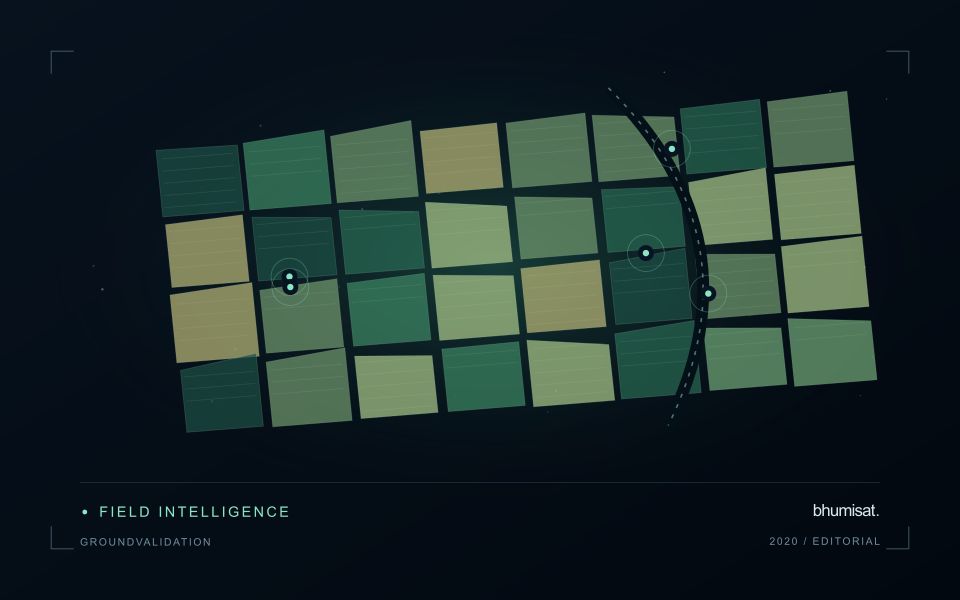
A validation visit should record cocoa condition and overstory characteristics separately. Photograph or describe the sampled area consistently, and retain its location and date so that it can be related to the observation footprint. Sampling only accessible farm edges risks overlooking different conditions in the interior. Reports should explain whether they describe whole-farm vegetation or a validated cocoa-specific measurement, and identify the additional evidence needed before a management recommendation can be made.
Start with the intended claim
Validation tests how well a product represents a defined quantity under specified conditions. It differs from calibration, which adjusts an instrument or model using reference information. Begin with the claim the product needs to support: class membership, surface reflectance, canopy height, water quality, or an area estimate. State the required spatial scale, time interval, and acceptable error. These choices determine the reference method and sample design. Collecting convenient field points first and deciding later what they prove usually leaves important conditions untested.
Reference measurements also contain uncertainty. Positioning error can place a sample in the wrong satellite pixel, a point instrument may not represent a heterogeneous footprint, and measurements made on different dates can describe real surface change. Record instrument calibration, sampling protocols, timestamps, coordinates, observation conditions, and uncertainty where available. For interpreted labels, retain the evidence used, class rules, and ambiguous cases. Agreement among interpreters is useful to examine, but agreement alone does not guarantee that the shared interpretation is correct.
Keep the assessment independent
Separate validation data from observations used to fit thresholds, train models, select features, or tune processing. If assessment sites repeatedly influence revisions, they have become development data and a fresh independent assessment is needed. Spatially clustered samples can make performance look stronger when neighboring training and test locations share conditions. Use a design that reflects the target population and report its limitations, including inaccessible areas or environmental conditions missing from the sample.
Choose metrics that match the product. For categorical maps, examine a confusion matrix and errors for individual classes, not just overall agreement. For continuous measurements, report bias and a suitable error measure alongside sample count and the range of reference values. Plot residuals against relevant conditions to expose failures hidden by an average. For area estimates, carry the probability sampling design through estimation and uncertainty calculations. Preserve rejected matchups and their reasons so that quality screening remains auditable. A useful validation report explains where the product works, where evidence is sparse, and which errors matter for the intended decision. Publishing reference protocols and assessment code makes later comparisons more credible and helps others reproduce the evaluation.
Keep an auditable review record
A review record should explain how a result moved from an analytical output to an accepted interpretation or operational decision. Preserve the product identifier, the evidence considered, the reviewer role, and the outcome of the review. A short, consistent record is often more useful than an extensive free-text note that cannot be compared between cases. The objective is to make important decisions traceable without turning routine review into unnecessary administrative work.
Separate observations from conclusions within the record. Describe the evidence visible to the reviewer, the alternative explanations considered where relevant, and the reason for accepting, qualifying, or rejecting the result. If a correction is required, identify what should change and how the revised product relates to the earlier version. Keep unresolved questions visible so that they can be addressed by another observation or by the person responsible for the next action.
Use the accumulated record to improve the workflow. Recurring review reasons can reveal unclear requirements, missing contextual information, unstable processing steps, or an evaluation gap. Examine whether similar cases receive similar decisions across reviewers and over time. Preserve the relationship between feedback and subsequent revisions so that improvements can be assessed against the evidence that motivated them. An auditable record supports learning, accountability, and consistent delivery while allowing the technical process to evolve.
Preserve a reproducible processing history
A result should be linked to the inputs and processing choices that produced it. Record source identifiers, software versions, configuration values, reference data versions, and the time of processing. The record does not need to expose every internal implementation detail to the end user. It must preserve enough information for the producing team to investigate a result, reproduce a comparison, and explain why a revised product differs from an earlier version.
Version changes that can affect the meaning of the output. Updated boundaries, a new quality mask, revised calibration, different model parameters, or altered aggregation rules can all change results even when the source imagery is unchanged. Avoid overwriting an earlier product without retaining a suitable history. A clear relationship between versions helps users distinguish an improvement in processing from a real change in the observed surface.
Use representative regression cases when modifying the workflow. Select cases that cover ordinary conditions and known failure modes, then compare meaningful outputs before and after the change. Investigate differences against the intended purpose of the revision rather than assuming that a closer visual match is always preferable. Preserve the review decision with the version record. Reproducibility becomes practical when the team can trace a result through a documented sequence of inputs, transformations, tests, and delivery decisions.
Bring the evidence back to the decision
Quality control is most useful when its results travel with the information being delivered. Preserve the reasons for accepting or rejecting an observation, and expose limitations that could change the user's interpretation. Review recurring failures as clues about the design of the workflow. A clear quality record supports consistent comparisons between operators and processing versions, while helping the team decide whether a problem originates in acquisition, preparation, interpretation, or the underlying observation requirements.
Sources & further reading
Explore the bhumisat spacecraft concept and our vision towards 2030, or return to the journal.