A useful observation programme begins with a decision that somebody can act on. Before selecting imagery or instruments, define the area of interest, the people responsible for inspecting it, and the time available for a response. This planning perspective connects remote measurements with the practical questions that shape a survey or monitoring service. The aim is to identify which observations would change a decision, how supporting evidence would be collected, and what should happen when information is incomplete. A clear plan makes later technical choices easier to assess against an operational purpose.
This working guide considers turning collected imagery into delivered data within mission readiness studies. The immediate decision is to connect mission claims to measured evidence. Useful reference evidence includes documented requirements, test results and unresolved design questions. The case is an illustrative planning context, with assumptions to check against the actual sensor, landscape and project requirements.
Start with the data that must reach users
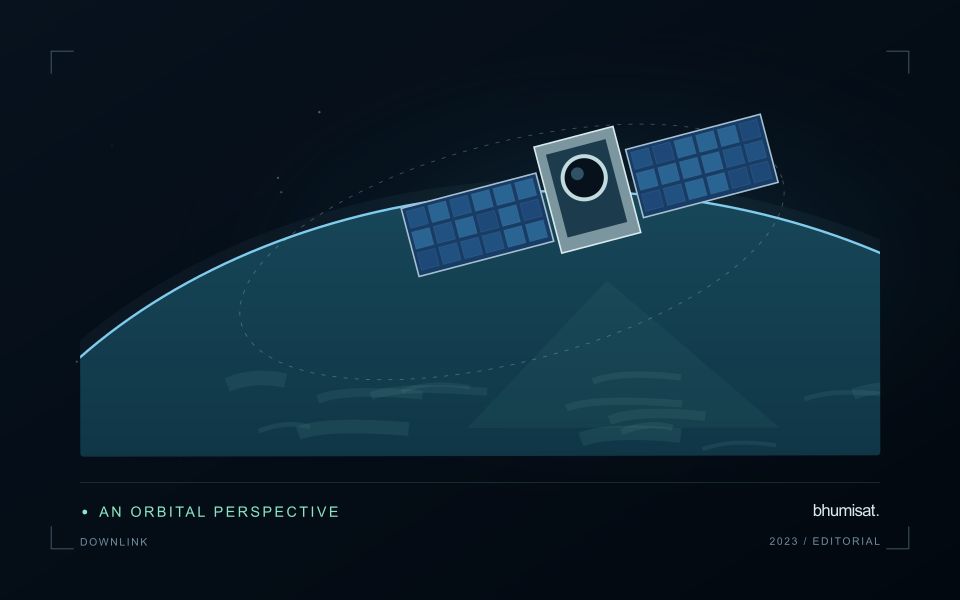
A satellite camera's collection rate and a radio's advertised bit rate do not determine how much useful imagery reaches the ground. The complete data path includes detector output, onboard processing, storage, contact scheduling, transmission and ground processing. Each stage can constrain delivery. Begin with an observation plan and estimate the data it generates, including spectral bands, sampling, encoding, metadata and housekeeping information.
Distinguish raw payload rate from the net rate available for science files. Framing, error control, protocol overhead and operational interruptions reduce effective throughput. Compression can lower volume, but its value depends on scene content and acceptable information loss. Test a representative range of imagery and assess whether any lossy approach alters the measurements needed by the application. A visually pleasing result is not sufficient evidence for quantitative analysis.
Model contacts, storage and recovery together
Ground contacts depend on orbit geometry, station location, visibility constraints and access to the station schedule. The highest rate may be available only during part of a pass. A link budget combines transmitter power, antenna gains, propagation loss, receiver performance and other losses to assess whether the required performance is feasible. Antenna orientation and spacecraft pointing must be consistent with imaging, power generation and other operating demands.
Use a time ordered simulation to track the stored data backlog. Add each planned acquisition and subtract the amount that can actually be delivered during usable contacts. Include missed passes, reduced rates and retransmission policy where relevant. Storage must accommodate plausible disruptions as well as nominal operation. Define priorities and deletion rules before the buffer fills, preserving the metadata needed to identify what was collected and what was lost.
The ground segment needs more than an antenna. It must authenticate commands where applicable, receive and verify files, detect gaps, maintain acquisition records and feed the processing pipeline. Measure latency from observation to the user's usable product, since a successfully received file may still wait for calibration or quality checks. End to end tests should exercise realistic file sizes and interrupted transfers. A sound delivery plan balances collection ambition with energy, contact time and processing capacity, so that an observation schedule produces a dependable flow of usable information.
The setting: Mission readiness studies
A mission readiness study connects the intended application with the evidence available from the spacecraft and ground system. A target launch year or an attractive rendering can help communicate a vision, but neither establishes that the observation service is ready. Begin with the capabilities the mission is supposed to demonstrate and identify how each will be assessed. Requirements should remain traceable to user needs rather than accumulating as an unrelated list of desirable specifications.
The review should consider the observation payload, pointing, power, communications, processing and delivery as parts of one chain. A promising subsystem test may still leave an important gap elsewhere in that chain. Record the conditions under which each result was obtained, the applicable uncertainty and the design version it represents. Changes in architecture or application requirements should trigger a review of which earlier evidence remains relevant and which measurements need to be repeated.
Progress can be organised around clear evidence milestones, including application trials, integrated testing and documented end-to-end demonstrations. Keep unresolved questions visible and distinguish a proposed capability from a measured one. A finding that leads to a design change is valuable information when it improves the match between the mission and its intended use. The practical result is a defensible account of readiness, remaining work and the conditions that must be satisfied before a stronger public performance claim can be supported.
Budget the complete processing workflow
A processing budget should cover the complete path from source observations to a maintained product. Data access and computing are only part of that path. Include preparation, geographic updates, reference collection, expert review, delivery, and support where those activities belong to the service. A calculation that runs cheaply on a small demonstration can still require substantial effort when the surrounding work is repeated across many locations.
Measure representative tasks rather than assuming that every observation costs the same amount to process. Record data volume, processing time, retry frequency, manual interventions, and the conditions that create unusually demanding cases. Separate fixed setup work from work that grows with the number of observations or users. These records support decisions about batching, caching, storage policy, and the point at which a different processing design becomes worthwhile.
Connect the budget to a defined level of service. Faster delivery, more frequent observation, broader coverage, or more detailed review can each change the resources required. Describe these trade-offs before promising a delivery pattern that the workflow has not demonstrated. Review the budget using operational evidence and preserve enough detail to understand changes between processing versions. The aim is a sustainable service whose resource choices remain aligned with the information that users value.
Check spatial alignment before comparison
A comparison between images, channels, maps, or field measurements assumes that the observations refer to the same locations at a suitable level of precision. Small alignment errors can become especially important near boundaries or narrow features. Before interpreting differences, inspect whether identifiable, stable features agree between the sources. A common coordinate reference is necessary for many workflows, but it does not by itself demonstrate accurate alignment.
Use control features that are appropriate for the observation scale and remain stable across the comparison period. Evaluate alignment in more than one part of the area, because a single location cannot reveal spatially varying distortion. Record the method used to estimate any correction and retain independent features for checking the corrected result. Where surfaces have genuinely changed, avoid using those changes as evidence of an alignment error.
Propagate the implications of remaining misalignment into the analysis. A workflow may exclude boundary pixels, summarise at a broader scale, or qualify interpretations for small features. The choice should follow the application rather than a preference for visually smooth output. Preserve both the original and corrected geographic references, and document resampling decisions so that future users can understand how measurements were moved onto a common spatial framework.
Bring the evidence back to the decision
The practical outcome should be a short observation plan that another team can follow. It should name the decision, the required evidence, the responsible roles, and the conditions that trigger a field visit or further analysis. Keep the plan small enough to test, then revise it using the results of real inspections. A useful monitoring workflow improves because its assumptions are examined systematically, and its observations remain connected to decisions throughout the process.
Sources & further reading
Explore the bhumisat spacecraft concept and our vision towards 2030, or return to the journal.