A method that produces a plausible result has not automatically demonstrated that it works for its intended users. Validation requires a defined question, suitable reference evidence, and an evaluation design that reflects how the method will be used. This perspective examines which observations should be compared, how they should be sampled, and which errors matter in practice. It also considers the difference between evidence used to develop a method and evidence reserved for evaluating it. The objective is a test that can reveal weaknesses as well as confirm useful performance.
This working guide considers keeping earth observation data usable over time across sediment-runoff catchments. The immediate decision is to connect sampling priorities across land and water. Useful reference evidence includes timed water samples, runoff context and land-cover observations. The case is an illustrative planning context, with assumptions to check against the actual sensor, landscape and project requirements.
The setting: Sediment-runoff catchments
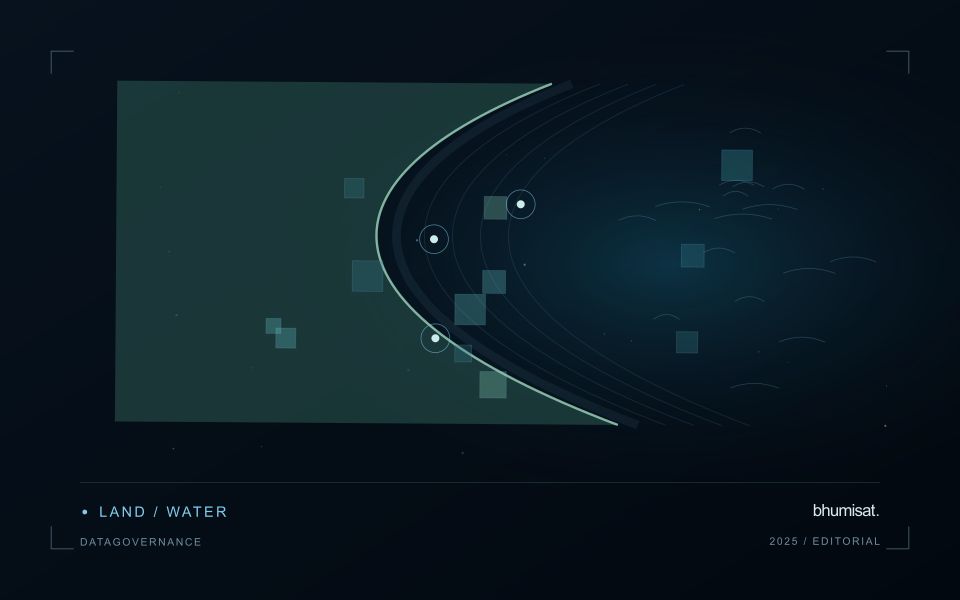
A catchment monitoring project connects land-cover patterns, drainage pathways and observations of receiving waters. These evidence streams operate at different spatial and temporal scales. A bare land patch or a bright water plume may be relevant to a sampling question, but an image alone does not establish that one caused the other. Define whether the task is mapping potential source areas, tracking a visible water pattern or evaluating a particular sediment-related variable.
Maintain suitable land and water masks and compare acquisitions with their rainfall and flow context where that information is available. Clouds can obscure the period of greatest interest, and conditions may change rapidly after runoff events. Land adjacency, shallow water and surface reflections can also affect optical interpretation. A useful monitoring record identifies the dates and valid areas supporting each observation instead of presenting a continuous causal story across missing measurements.
Field validation should collect water measurements with clear location, timing and sampling methods, alongside the evidence used to describe land conditions. Sampling only the most obvious plume may overlook other parts of the response or ordinary background variation. More specific source attribution needs an investigation designed for that claim. A practical first product can organise catchment observations and prioritise coordinated sampling, while keeping remotely observed associations distinct from explanations established through additional measurements.
Define the responsibilities around the files
Data governance is the set of practical decisions that makes an archive trustworthy and usable. It covers who can publish a product, who maintains its description, how corrections are approved and how users discover changes. These responsibilities matter even for a small project. Without them, an attractive map may become detached from its source scenes, processing method and known limitations.
Assign stable identifiers to datasets and distinguish a collection from its individual files. Record the producer, contact route, geographic extent, time coverage, coordinate reference system, units and missing value conventions. Describe the processing level and whether the values represent measurements, corrected observations or model estimates. A clear data dictionary is especially important when a compact code or numeric flag carries a meaning that would otherwise remain implicit.
Preserve context as products evolve
Maintain provenance from source acquisition through processing and publication. Preserve source identifiers, algorithm versions, parameter settings and links to validation material. When a correction changes values, create a traceable version rather than silently replacing a file and leaving its description untouched. Explain the reason for the revision and whether earlier analyses should be revisited. Checksums help detect changes or corruption but cannot establish that a scientific interpretation is correct.
Access rules should reflect the actual data and agreements involved. Public satellite imagery does not automatically make every associated field record or derived dataset unrestricted. Location records may reveal sensitive ecological sites, and field photographs may include identifiable people. Review the relevant terms before combining or distributing sources, and express reuse conditions in plain language with a suitable license where appropriate. Preserve acknowledgement and citation requirements alongside the data.
Plan retention, backups and recovery before storage becomes crowded. Keep essential documentation and reproducible processing materials with the deliverable, while identifying intermediate files that can be regenerated. Test that a restored copy opens correctly and has the expected metadata. A release checklist should include file integrity, machine readable metadata, readable documentation and a useful contact path. Periodic stewardship reviews can detect broken links, obsolete formats and orphaned responsibilities. The aim is a product that remains interpretable after the original analyst has moved on.
Deliver quality flags that users can interpret
Quality information should describe the condition of an observation in terms that remain useful through the workflow. A single valid or invalid label may be sufficient for some calculations, but operational users often need to know why an observation was qualified. Distinguish acquisition limitations, processing failures, uncertain reference matches, and conditions that make interpretation ambiguous. These categories point towards different responses and should not be merged without a clear purpose.
Define a small, documented set of flags with stable meanings. Record whether a flag applies to a complete scene, a geographic unit, an individual measurement, or a derived result. A unit containing a mixture of qualified and unqualified observations may also require a coverage measure. Include the rule used to combine flags when summarising data so that a favourable average does not conceal a substantial fraction of unusable input.
Test the flags with the people receiving the product. Ask what they would do differently for each state and whether the terminology supports that choice. Keep the original flags available even if the interface presents a simpler summary. When flag definitions change, version the rules and review their effects on historical comparisons. Useful quality communication makes the condition of the evidence visible at the moment when a user decides how much confidence to place in the result.
Preserve a reproducible processing history
A result should be linked to the inputs and processing choices that produced it. Record source identifiers, software versions, configuration values, reference data versions, and the time of processing. The record does not need to expose every internal implementation detail to the end user. It must preserve enough information for the producing team to investigate a result, reproduce a comparison, and explain why a revised product differs from an earlier version.
Version changes that can affect the meaning of the output. Updated boundaries, a new quality mask, revised calibration, different model parameters, or altered aggregation rules can all change results even when the source imagery is unchanged. Avoid overwriting an earlier product without retaining a suitable history. A clear relationship between versions helps users distinguish an improvement in processing from a real change in the observed surface.
Use representative regression cases when modifying the workflow. Select cases that cover ordinary conditions and known failure modes, then compare meaningful outputs before and after the change. Investigate differences against the intended purpose of the revision rather than assuming that a closer visual match is always preferable. Preserve the review decision with the version record. Reproducibility becomes practical when the team can trace a result through a documented sequence of inputs, transformations, tests, and delivery decisions.
Bring the evidence back to the decision
The validation record should explain the population represented by the test, the reference observations used, and the limitations of the comparison. Report meaningful errors alongside useful successes, and retain examples that challenge the method. Treat wider deployment as a new opportunity to evaluate transfer across relevant conditions. A well-designed validation programme gives users a defensible basis for deciding where the method is useful, where additional evidence is needed, and where another approach may be appropriate.
Sources & further reading
Explore the bhumisat spacecraft concept and our vision towards 2030, or return to the journal.