Remote observations show patterns, while practical decisions depend on explaining what those patterns could mean. Interpretation therefore requires more than locating a high or low value on a map. A useful analysis considers the timing of the observation, the physical processes that influence the measurement, and the information available from complementary sources. This perspective separates an observed signal from a proposed explanation and from an action recommended to a user. Keeping those stages distinct makes it easier to investigate alternative causes, communicate ambiguity, and choose a proportionate next step.
This working guide considers keeping earth observation data usable over time within mission readiness studies. The immediate decision is to connect mission claims to measured evidence. Useful reference evidence includes documented requirements, test results and unresolved design questions. The case is an illustrative planning context, with assumptions to check against the actual sensor, landscape and project requirements.
Define the responsibilities around the files
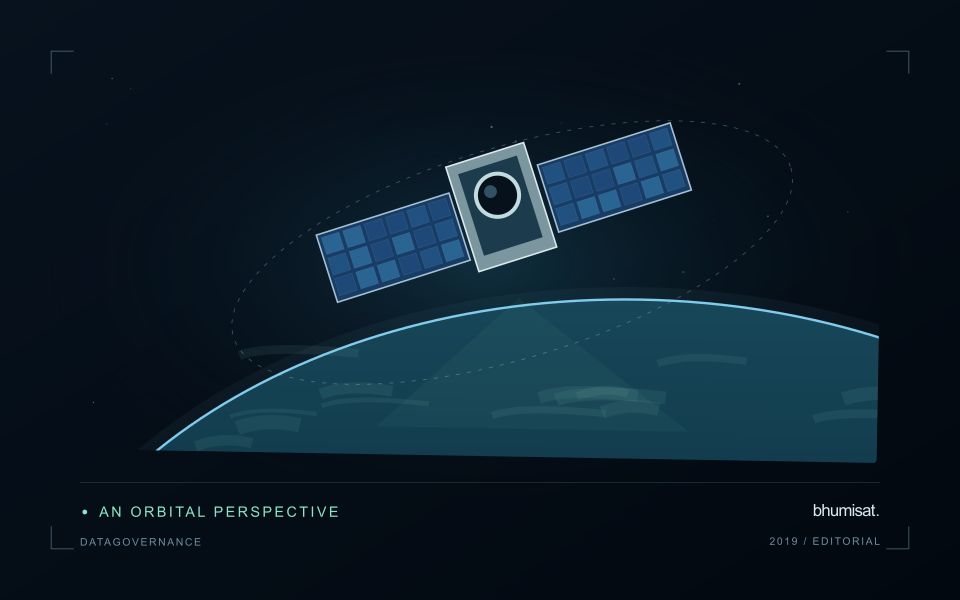
Data governance is the set of practical decisions that makes an archive trustworthy and usable. It covers who can publish a product, who maintains its description, how corrections are approved and how users discover changes. These responsibilities matter even for a small project. Without them, an attractive map may become detached from its source scenes, processing method and known limitations.
Assign stable identifiers to datasets and distinguish a collection from its individual files. Record the producer, contact route, geographic extent, time coverage, coordinate reference system, units and missing value conventions. Describe the processing level and whether the values represent measurements, corrected observations or model estimates. A clear data dictionary is especially important when a compact code or numeric flag carries a meaning that would otherwise remain implicit.
Preserve context as products evolve
Maintain provenance from source acquisition through processing and publication. Preserve source identifiers, algorithm versions, parameter settings and links to validation material. When a correction changes values, create a traceable version rather than silently replacing a file and leaving its description untouched. Explain the reason for the revision and whether earlier analyses should be revisited. Checksums help detect changes or corruption but cannot establish that a scientific interpretation is correct.
Access rules should reflect the actual data and agreements involved. Public satellite imagery does not automatically make every associated field record or derived dataset unrestricted. Location records may reveal sensitive ecological sites, and field photographs may include identifiable people. Review the relevant terms before combining or distributing sources, and express reuse conditions in plain language with a suitable license where appropriate. Preserve acknowledgement and citation requirements alongside the data.
Plan retention, backups and recovery before storage becomes crowded. Keep essential documentation and reproducible processing materials with the deliverable, while identifying intermediate files that can be regenerated. Test that a restored copy opens correctly and has the expected metadata. A release checklist should include file integrity, machine readable metadata, readable documentation and a useful contact path. Periodic stewardship reviews can detect broken links, obsolete formats and orphaned responsibilities. The aim is a product that remains interpretable after the original analyst has moved on.
The setting: Mission readiness studies
A mission readiness study connects the intended application with the evidence available from the spacecraft and ground system. A target launch year or an attractive rendering can help communicate a vision, but neither establishes that the observation service is ready. Begin with the capabilities the mission is supposed to demonstrate and identify how each will be assessed. Requirements should remain traceable to user needs rather than accumulating as an unrelated list of desirable specifications.
The review should consider the observation payload, pointing, power, communications, processing and delivery as parts of one chain. A promising subsystem test may still leave an important gap elsewhere in that chain. Record the conditions under which each result was obtained, the applicable uncertainty and the design version it represents. Changes in architecture or application requirements should trigger a review of which earlier evidence remains relevant and which measurements need to be repeated.
Progress can be organised around clear evidence milestones, including application trials, integrated testing and documented end-to-end demonstrations. Keep unresolved questions visible and distinguish a proposed capability from a measured one. A finding that leads to a design change is valuable information when it improves the match between the mission and its intended use. The practical result is a defensible account of readiness, remaining work and the conditions that must be satisfied before a stronger public performance claim can be supported.
Organise imagery and results for reliable retrieval
A useful storage design helps people and software find the right observation without relying on informal knowledge of folder names. Separate immutable source data from temporary processing files and delivered products. Give each observation a stable identifier and preserve its acquisition metadata alongside the file. A predictable organisation reduces the chance that a later analysis accidentally uses a preview, an outdated result, or an intermediate product whose meaning has not been documented.
Choose an indexing scheme that reflects the questions the workflow needs to answer. Location, acquisition time, source, product type, and processing version are often useful search dimensions. The physical arrangement of files can differ from the logical catalogue, provided that the relationship is maintained reliably. Record checksums or other integrity information where appropriate, and test whether an observation can be recovered using the catalogue rather than a particular operator's memory.
Define retention rules for source, intermediate, and delivered information. Some intermediate products are inexpensive to reproduce, while others embody costly preparation or expert review. Keep the inputs and configuration needed to rebuild a result before removing reproducible files. Test backup and recovery procedures with representative products, including their metadata and geographic references. Reliable retrieval is demonstrated by a successful reconstruction of useful information, rather than by the existence of an untested copy.
Design an evaluation that reflects deployment
A model evaluation should resemble the conditions in which the model will be used. Start by identifying which relationships the development data share: nearby locations, repeated observations of the same unit, common collection teams, or measurements from a single period. These relationships can make records less independent than they appear. An evaluation that ignores them may test the ability to recognise familiar conditions rather than the ability to operate in a new setting.
Choose a split strategy that matches the intended transfer. Holding out locations, seasons, operational units, or acquisition conditions can answer different questions. Document which question each split is designed to address, and keep the held-out evidence separate while selecting features and tuning the method. Repeatedly inspecting the same evaluation set to improve a model gradually makes that set part of development, even if it retains its original label.
Report results at a scale that is meaningful to the user. A strong average can hide poor performance for important subgroups or unusual conditions. Examine error patterns and retain examples of both successful and unsuccessful predictions. Where the evidence covers only a limited range of conditions, describe that range explicitly. The evaluation then becomes a practical guide to suitable use, further testing, and the collection of additional reference observations.
Bring the evidence back to the decision
A strong interpretation states what was observed, which explanations remain plausible, and what additional evidence would help distinguish them. Avoid presenting a convenient label as a confirmed cause when the measurements support only a broader pattern. Connect the proposed next step to the significance of the decision and the confidence available. This creates an interpretation that a field team, analyst, or project partner can examine, challenge, and improve as further observations become available.
Sources & further reading
Explore the bhumisat spacecraft concept and our vision towards 2030, or return to the journal.