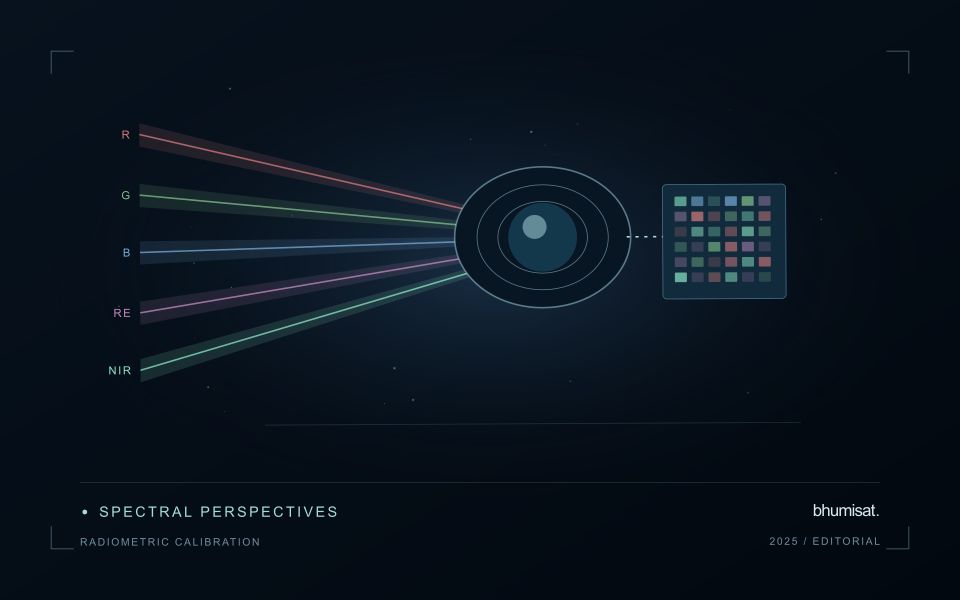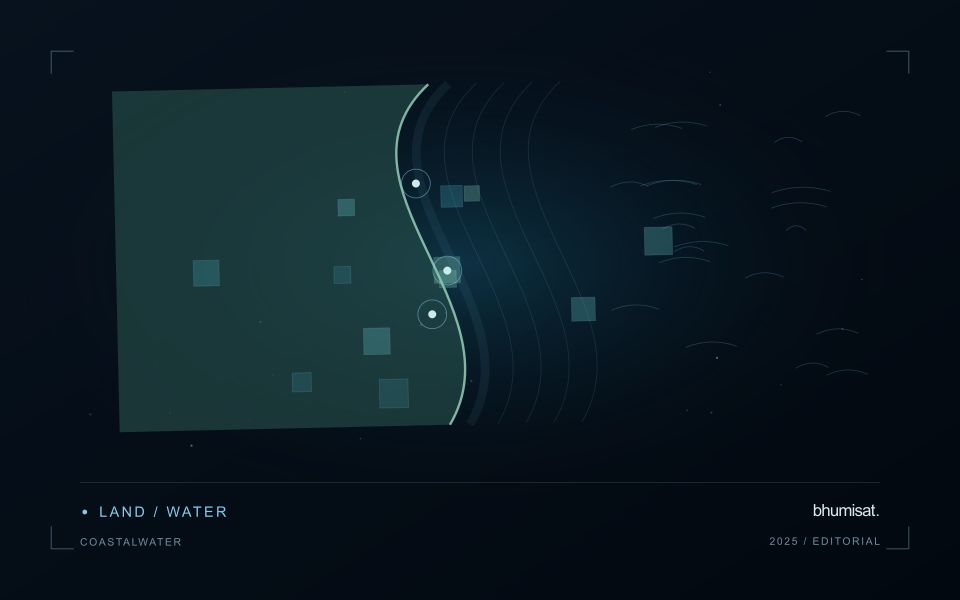
A convincing image can still contain measurements that are unsuitable for a particular task. Quality control asks whether the inputs, transformations, and outputs meet the requirements of the intended application. This perspective follows evidence through the workflow, from acquisition metadata and reference observations to the final interpretation. It encourages teams to define acceptance conditions before seeing the result, rather than adjusting them to favour a preferred conclusion. The purpose is a repeatable way to distinguish usable observations, observations requiring qualification, and observations that should be excluded from a decision.
This working guide considers estimating coastal water quality from ocean colour across sediment-runoff catchments. The immediate decision is to connect sampling priorities across land and water. Useful reference evidence includes timed water samples, runoff context and land-cover observations. The case is an illustrative planning context, with assumptions to check against the actual sensor, landscape and project requirements.
Identify the quantity behind the colour
Coastal water colour carries information about materials that absorb and scatter light, including phytoplankton pigments, suspended particles, and dissolved organic matter. A satellite measures radiation reaching the sensor; estimating water quality requires separating the atmospheric contribution and then interpreting the remaining water signal. Specify the target variable and units before choosing an algorithm. Chlorophyll concentration, turbidity, suspended sediment concentration, and water clarity are related in some settings, but they are not interchangeable measurements.
Coasts are especially difficult because several optically active constituents can vary independently. A band ratio calibrated for clear offshore water may fail in a sediment rich estuary. Reflected light from nearby land can contaminate coastal pixels, sun glint can dominate the surface signal, and shallow bottoms can influence apparent colour. Cloud, haze, whitecaps, and mixed land water pixels further reduce usable coverage. Selecting an atmospheric correction method and applying its quality flags are scientific choices, not merely file preparation. Examine spectra and spatial patterns before accepting a plausible looking concentration map.
Match observations to a changing coast
Design validation around the speed of coastal change. Field measurements taken several hours away from the satellite overpass may describe another water mass after tides, currents, or river discharge have shifted conditions. Record sampling time, position, depth, instrument calibration, laboratory methods, and the spatial variability around each station. Satellite pixels integrate an area, while a bottle sample represents a much smaller volume. Use suitable matchups and inspect surrounding pixels rather than pairing every station with the nearest value automatically.
Develop or select retrieval relationships using samples that span the expected range of conditions. Reserve independent data for evaluation and report bias, error, valid sample count, and cases rejected by quality screening. Compare algorithms on the same matchups to avoid misleading differences caused by sampling. Provide acquisition dates, water masks, uncertainty information, and clearly labeled units with every map. A surface optical product does not establish conditions throughout the water column, and a pigment estimate does not by itself identify a harmful species or toxin. Used with field observations and local hydrology, the imagery can reveal spatial gradients and help prioritize where additional sampling is needed.
The setting: Sediment-runoff catchments
A catchment monitoring project connects land-cover patterns, drainage pathways and observations of receiving waters. These evidence streams operate at different spatial and temporal scales. A bare land patch or a bright water plume may be relevant to a sampling question, but an image alone does not establish that one caused the other. Define whether the task is mapping potential source areas, tracking a visible water pattern or evaluating a particular sediment-related variable.
Maintain suitable land and water masks and compare acquisitions with their rainfall and flow context where that information is available. Clouds can obscure the period of greatest interest, and conditions may change rapidly after runoff events. Land adjacency, shallow water and surface reflections can also affect optical interpretation. A useful monitoring record identifies the dates and valid areas supporting each observation instead of presenting a continuous causal story across missing measurements.
Field validation should collect water measurements with clear location, timing and sampling methods, alongside the evidence used to describe land conditions. Sampling only the most obvious plume may overlook other parts of the response or ordinary background variation. More specific source attribution needs an investigation designed for that claim. A practical first product can organise catchment observations and prioritise coordinated sampling, while keeping remotely observed associations distinct from explanations established through additional measurements.
Budget the complete processing workflow
A processing budget should cover the complete path from source observations to a maintained product. Data access and computing are only part of that path. Include preparation, geographic updates, reference collection, expert review, delivery, and support where those activities belong to the service. A calculation that runs cheaply on a small demonstration can still require substantial effort when the surrounding work is repeated across many locations.
Measure representative tasks rather than assuming that every observation costs the same amount to process. Record data volume, processing time, retry frequency, manual interventions, and the conditions that create unusually demanding cases. Separate fixed setup work from work that grows with the number of observations or users. These records support decisions about batching, caching, storage policy, and the point at which a different processing design becomes worthwhile.
Connect the budget to a defined level of service. Faster delivery, more frequent observation, broader coverage, or more detailed review can each change the resources required. Describe these trade-offs before promising a delivery pattern that the workflow has not demonstrated. Review the budget using operational evidence and preserve enough detail to understand changes between processing versions. The aim is a sustainable service whose resource choices remain aligned with the information that users value.
Keep an auditable review record
A review record should explain how a result moved from an analytical output to an accepted interpretation or operational decision. Preserve the product identifier, the evidence considered, the reviewer role, and the outcome of the review. A short, consistent record is often more useful than an extensive free-text note that cannot be compared between cases. The objective is to make important decisions traceable without turning routine review into unnecessary administrative work.
Separate observations from conclusions within the record. Describe the evidence visible to the reviewer, the alternative explanations considered where relevant, and the reason for accepting, qualifying, or rejecting the result. If a correction is required, identify what should change and how the revised product relates to the earlier version. Keep unresolved questions visible so that they can be addressed by another observation or by the person responsible for the next action.
Use the accumulated record to improve the workflow. Recurring review reasons can reveal unclear requirements, missing contextual information, unstable processing steps, or an evaluation gap. Examine whether similar cases receive similar decisions across reviewers and over time. Preserve the relationship between feedback and subsequent revisions so that improvements can be assessed against the evidence that motivated them. An auditable record supports learning, accountability, and consistent delivery while allowing the technical process to evolve.
Bring the evidence back to the decision
Quality control is most useful when its results travel with the information being delivered. Preserve the reasons for accepting or rejecting an observation, and expose limitations that could change the user's interpretation. Review recurring failures as clues about the design of the workflow. A clear quality record supports consistent comparisons between operators and processing versions, while helping the team decide whether a problem originates in acquisition, preparation, interpretation, or the underlying observation requirements.
Sources & further reading
Explore the bhumisat spacecraft concept and our vision towards 2030, or return to the journal.